
Five cities, five expos, one season – and then something new
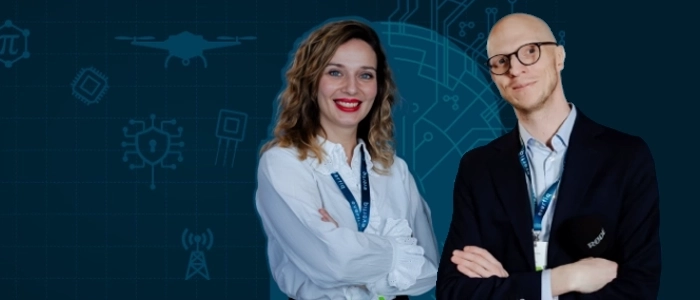
Dennis Dahlgren and Ewelina Bednarz reflect on the spring Expo season and look ahead to their first trip to the International in4ma EMS & PCB Forum in Würzburg.
Dennis: Five expos in roughly four months. Tampere, Zürich, Lund, Kraków, Berlin. Before we get into the specifics – what's your overall impression of the spring season?
Ewelina: What struck me most wasn't any individual event, but how much the separate programmes ended up telling the same story. You'd have a conversation in Zürich about memory market volatility, and then a week later in Kraków someone would be talking about supply chain resilience from a completely different angle – and the two would connect. By the time we got to Berlin, it felt like the industry had spent the spring workshopping the same questions in different cities. How exposed are we? What does a more resilient European manufacturing base actually look like? What's the honest competitive position right now? The format differed, the languages differed, but the underlying urgency was remarkably consistent.
What also stood out was how much audience questions have evolved. A few years ago, discussions focused on growth and new opportunities. This spring, people were increasingly asking about resilience, supply chains and long-term stability. The focus has shifted from expansion to adaptation.
Dennis: I'd agree with that, though I'd frame it slightly differently. The shift from expansion to adaptation – I'd go one step further and call it forced honesty. The conversations I kept having, in Tampere, in Zürich, in Lund, and again in Berlin, were with people who weren't pretending anymore. Nobody was talking about a return to the pre-2020 supply chain model. The question was how do you build a new one – a tougher one?
First stop: Tampere
Ewelina: Tampere kicked things off in March – and that was just you. What did you take home?
Dennis: The easy answer is Riku Hynninen from Agame. His presentation on European EMS strategy, acquisitions and the defence boom was data-heavy and concrete – exactly what I respond to.
But if I'm honest about what stayed with me longest, it was the scholarship. I had the privilege of announcing the winners and handing out the award to Razib Hasan and Jingjing Yang, two engineering students whose thesis explores non-invasive glucose monitoring using light instead of needles. I spend most of my time thinking about this industry in terms of numbers. This was a useful reminder of what it all connects back to.
Ewelina: That's a side of the Expo I don't always think about. I'd have expected you to come back talking about the EMS numbers.
Dennis: I did, and had my own presentation about it. But the scholarship stuck with me more.
The Swiss debut: Zürich
Dennis: Zürich was next – and that was the debut. First time we'd run anything in Switzerland. It was also your first expo of 2026. Were you apprehensive?
Ewelina: Less apprehensive, more curious. Switzerland isn't a market you can read in advance. But it worked – completely.
For me the highlight was the technical sessions. Patrick Stockbrügger from LPKF, Daniel Schulze from Dyconex, Dimitri Kokkinis from Cicor. The room stayed full. People were taking notes and asking detailed follow-up questions. As someone involved in shaping conference programmes, it was encouraging – it suggests there's a real appetite in the Swiss market for engineering-focused content, not just market overviews. How about you?
Dennis: I was so wrapped up in the analyst conversations that I wasn't watching the room the same way. I spent a long time with Nikolaos Florous going back and forth on the memory market – the kind of exchange you can't get from reading a presentation afterwards. Same with Claus Aasholm on the structural shift in the semiconductor cycle. Those conversations shifted how I think about both topics. That was Zürich for me.
Ewelina's territory: Kraków
Dennis: Kraków was yours. How was it?
Ewelina: Strong. I think it's developing into one of the sharpest events in the programme.
The opening panel, which I had the pleasure of moderating, brought together Maciej Sobolewski from Fideltronik and Jacek Małecki from Best Supply. What made it work was that the questions raised during that session didn't disappear once it ended. They kept resurfacing throughout the day, creating a thread between presentations on supply chains, manufacturing resilience and operating in demanding environments.
Małecki's session on the components market was the one I found most valuable. Supply chain risk and volatility, drawn from real distribution and EMS experience – not industry narratives, actual numbers and patterns. The room responded strongly.
I was also pleased by the engagement during the closing session on Europe's largest defence companies. It showed how closely developments in defence, industrial policy and electronics manufacturing have become intertwined.
Dennis: And attendance-wise?
Ewelina: Strong. A notably large share of first-time attendees, which is always a good sign for a market.
Back to the beginning: Lund
Ewelina: Then Lund – the 15th anniversary, back in the city where it all started. How was that?
Dennis: Which added a layer. Being back in Lund, at a different venue, for the anniversary – that was its own thing.
The highlights were Mahdi Fazeli’s presentation on hardware Trojans and supply chain security – one of those talks where you walk out slightly unnerved, which is probably the correct response – and Claus Aasholm doing what he does, making the semiconductor market legible to people who aren't analysts full-time.
I also presented myself this time. The Swedish EMS analysis – the ten-factory, half-the-market piece. It could have gone better in certain respects, but the response was good. I'll be taking it to Gothenburg in September.
Ewelina: That's the first time I've heard you describe your own presentation as something that "could have gone better." Usually, you're fairly even-handed about these things.
Dennis: I'm always even-handed. That was even-handed.
End of the line: Berlin
Ewelina: Berlin closed out the season – and the first time at the new venue in Siemensstadt. What do you take from it, Dennis?
Dennis: What I kept running into in Berlin – in conversations more than presentations – was proximity. Regional partnerships, shorter distances, direct contact. Companies that spent years optimising for cost are now re-weighting for reliability and reaction speed. It's not a new theme. But Berlin felt like the point where it had stopped being something people talked about and had moved to something they were actively working on.
And of course in4ma's session was the highlight for me, as it seemed to be for many visitors as well.
Ewelina: Berlin felt like the point where everything came together. The question of European competitiveness stopped being abstract. The in4ma session – Dieter Weiss, Mareike Haass and Eric Miscoll – put real data on the table. No optimistic framing, just the numbers. The audience was photographing slides and debating the figures long after the session ended. When that happens, you know you've had a hit.
Mira Grünhaupt's presentation on AI in production planning was another that cut through. Not because AI is a new topic – it isn't – but because she stayed specific and practical, which most AI presentations in this industry don't — they tend to be abstract.
Next stop: Würzburg
Ewelina: Which brings us to what's next. The in4ma EMS & PCB Forum in Würzburg, July 8 and 9. You've covered in4ma's research for years. Why have you never gone before – and why now?
Dennis: The timing finally worked, for one thing. We've been invited before and it never aligned. But also – after five expos and months of coverage built heavily on in4ma's data, it felt like the right moment to actually be in the room. We've been reporting on this research from the outside. Now we get to see where it's presented and debated by the people it's about.
Ewelina: It's also genuinely different from most of what we covered in the Evertiq Expo programmes. A closed-format conference, built around strategy and market analysis rather than the trade fair model. Four thematic blocks in a single day. The programme is concentrated in a way that should generate real discussion.
Dennis: The EIPC session on European PCB manufacturing alone would justify the trip for me. "PCBs made in Europe: a future between cost pressure and technological leadership" – This is something that needs to be discussed louder.