
Growth surge masks structural strain in semiconductor market
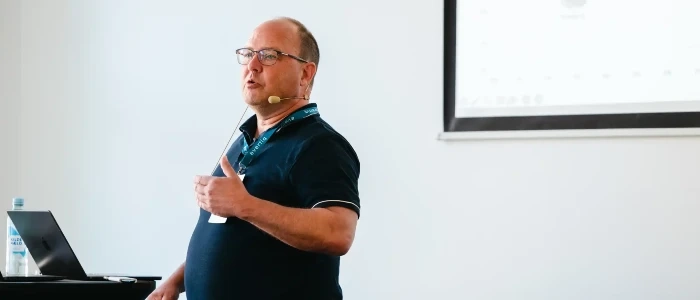
During Evertiq Expo Zurich on April 23, 2026, Claus Aasholm, founder of Semiconductor Business Intelligence, offered a pointed assessment of a semiconductor industry growing rapidly — but not evenly. In his keynote and a follow-up conversation, Aasholm argued that while headline figures suggest unprecedented expansion, underlying dynamics point to structural imbalances across the supply chain.
One key concern is the lack of growth in materials – a factor Aasholm sees as a fundamental constraint on the industry's ability to sustain its current trajectory.
"One of the most important slides that I showed is that materials are not growing," he said. While technological development has historically allowed the industry to do more with less, that logic has limits. "When you're doubling in a very short time, you need meaningful development in material usage. That's not happening."
At the same time, pricing – particularly in memory – is reaching levels that Aasholm described as detached from normal market logic.
"We are still in the balloon phase," he said. "GPUs are still expensive, and now memory is going from expensive to insane. I can see 80% gross margins — and I think it could go higher."
While profitable in the short term, such conditions risk slowing broader adoption and distorting market behaviour across the supply chain.
Diverging cycles across the industry
Beyond memory and AI, not all segments are moving in the same direction. Aasholm pointed to ICAPS segments – IoT, communications, automotive, power and sensors – as operating on a fundamentally different cycle than AI-driven growth areas.
Despite having available capacity and elevated inventory levels, some companies in these segments are raising prices. "This is illogical," Aasholm said. The explanation, he argued, is not demand strength but a lack of visibility – companies uncertain about what to build are making mistakes, and passing the cost on. "They may have capacity, but not the right capacity."
At the same time, many are making deliberate strategic shifts toward AI-related business – not out of necessity, but in pursuit of higher margins. "We need to participate in AI, and we are going to sacrifice something else for doing this," he said.
The consequences of that trade-off are already visible. Industries with long qualification cycles – automotive and industrial electronics in particular – are seeing critical components phased out without adequate replacements.
"That's actually what I worry about most," Aasholm said. The path to higher margins is clear; the cost to everyone else is less so.
The risk of over-indexing on AI
One of the sharper exchanges in the conversation concerned whether memory companies are already making that mistake. The observation that they risk focusing too much on high-margin AI products at the expense of everything else drew an immediate response from Aasholm.
"We're already seeing it," he said. "Client and mobile customers are now getting one third less than they did a few quarters ago."
The short-term logic is straightforward – allocate everything to AI, capture the margin. But Aasholm questioned where it leads.
"You want to make sure that people have PCs. What is the AI going to run on? You need a phone, you need memory — and it's going to go crazy."
The temptation, he acknowledged, is enormous. "Think about it – out of 100 dollars, they'll get 82 back right now. It's insane." Whether the memory companies can resist the pull of that margin long enough to maintain a broader market is, in his view, one of the defining questions of the current cycle.
Europe at a crossroads
Aasholm also addressed the geopolitical dimension of the current market, pointing to increasing regionalisation as a structural shift rather than a temporary disruption. The US, Europe and China are all moving toward greater self-reliance – a process he sees as accelerating regardless of political cycles.
"What we thought was a partner is not at all a partner," he said of the US. "Japan, Taiwan, Europe – everybody is waking up to that." The response, he argued, needs to go beyond semiconductors. "We need to build sovereign infrastructure – not only in AI, but in manufacturing, supply chain, everything."
For Europe specifically, the moment presents both a gap and an opening. Aasholm pointed to weaknesses in materials, tool chains and manufacturing capacity, arguing that current initiatives are too narrowly focused on wafer fabrication.
"I think that's not the main problem. The Taiwanese will happily support us." What Europe lacks is breadth – a full ecosystem rather than isolated points of strength.
He was also direct about where the opportunity lies. ICAPS segments are being de-emphasised by US and Asian players chasing AI margins. Europe already holds competitive positions in some of these areas.
"We might end up with the most important products on European soil – because everybody else is walking away from them."
Clean technology and sustainability frameworks, long seen as regulatory burdens, may prove to be export advantages.
A supercycle – just not evenly distributed
Looking ahead, Aasholm expects 2026 to continue the pattern he has previously described as a split semiconductor supercycle, growth concentrated rather than broad, with the gap between winners and the rest widening further.
"I think the tide will lift almost all ships – but not equally," he said. Memory companies are expected to reach unprecedented profitability levels, driven by sustained AI demand. Nvidia, by contrast, he sees as having reached cruise speed – still growing, still impressive, but no longer accelerating in the way that defined recent years.
The larger question hanging over the market is whether the anticipated demand is real or deferred. Data centre buildout remains largely forward-looking.
"It's all being built in anticipation of something that's not fulfilled yet," Aasholm said. The hyperscalers remain committed – but commitment and delivery are not the same thing.
Even segments expected to soften have held up. "I had expected PC and mobile demand to go down. But it's not," he said. The supercycle, for now, continues. Whether the industry uses the current window to address its structural imbalances – or simply extracts margin until the cycle turns – is the question 2026 will begin to answer.
Claus Aasholm will take the stage at Evertiq Expo Kraków on May 7 and Evertiq Expo Lund on May 21, where he will present "The Semiconductor Industry as it is, not as it is told."