


When light replaces needles: Evertiq Scholarship winners 2026
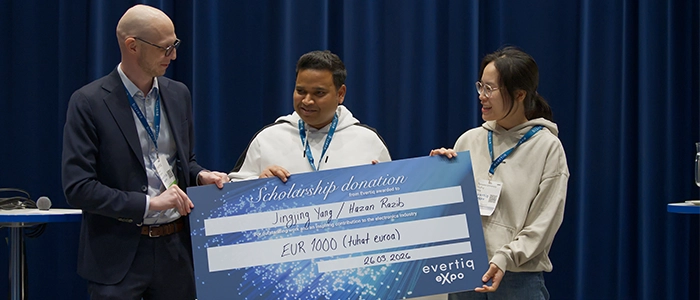
At Evertiq Expo Tampere on March 26, the moment was brief but meaningful. A check was handed over, applause followed, and two students – Razib Hasan and Jingjing Yang – stood on stage, representing something much bigger than a thesis project.
Their idea begins with a simple question: what if something essential didn’t have to hurt?
For millions of people living with diabetes, monitoring blood glucose levels is a daily routine – one that often involves needles, skin penetration, and discomfort.
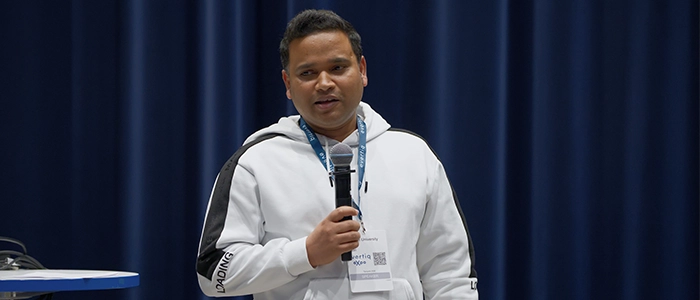
“Every time you penetrate a diabetic patient’s skin, it becomes prone to infection,” Razib explained during their presentation. “And it takes much longer to heal.”
That reality became the starting point for their work.
Letting light do the work
Instead of puncturing the skin, Hasan and Yang turned to something less intrusive: light.
Their thesis explores a non-invasive glucose monitoring system based on infrared spectroscopy. The idea, as Razib put it, is almost intuitive. Light doesn’t just pass through an object – it carries information with it. By measuring how specific wavelengths are absorbed when passing through the body, it may be possible to estimate glucose levels without ever drawing blood.
On stage, he compared it to how light intensity changes as it passes through material – like a curtain, for example.
But behind that simplicity lies a complex system.
Their prototype combines infrared LEDs, optical filtering, photodiode detection, and signal processing – paired with data handling and a mobile interface. Jingjing Yang’s contribution focused on refining the approach through a multi-wavelength design, selecting specific infrared bands to isolate glucose signals from other biological noise.
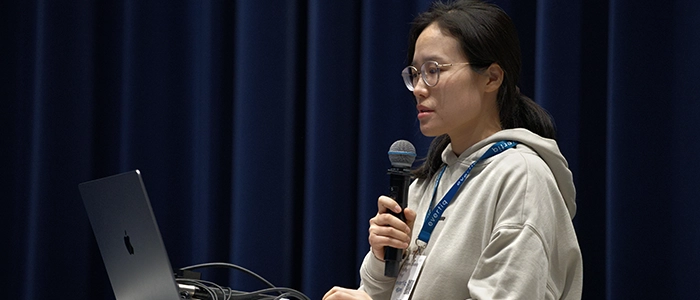
“We want to isolate the glucose signal from all the information we get,” she explained.
The system is still early-stage, tested in controlled lab environments using glucose solutions rather than human tissue. But even at this stage, the results show promising patterns – enough to suggest that the idea holds.
Building something from uncertainty
What makes their story compelling isn’t just the ambition, it’s how they got there.
“This project starts with a lot of uncertainty,” Yang said in the interview afterwards. “We had to build everything step by step, and we learned along the way.”
Both come from a stronger background in software than in hardware. Suddenly, they found themselves navigating optics, medical literature, and analog electronics – fields that demanded a different kind of thinking.
One of the biggest challenges? Extracting meaningful data from weak and noisy signals.
“The signal is very weak, but the noise is from multiple sources,” Yang explained. “It’s quite challenging to extract useful information.”
Razib adds another layer: identifying the right wavelengths wasn’t straightforward either. “We had to go through a lot of medical journals,” he said. “Pinpointing the exact nanometer – it was hard.”
Still, they persisted, breaking the problem down, simplifying it, testing it in controlled steps.
A personal starting point
Like many meaningful engineering ideas, this one didn’t start in a lab. It started at home.
“My father has to go to the hospital for blood testing, and he doesn’t really like it,” Razib shared. The initial idea wasn’t to build a certified medical device – it was to create something simpler. A way to check if something might be wrong.
“A checkpoint,” he called it. “Like – okay, is it something serious?”
From there, the perspective widened. What began as a personal problem turned into a global one.
According to research, about 830 million people worldwide have diabetes, facing similar challenges. That realisation changed the scope of the project – not just as a technical challenge, but as a potential contribution to everyday wellbeing.
Not a final product, but a direction
The system they’ve built is not ready for clinical use. They’re clear about that.
The next steps are equally grounded: improve signal quality, gather more data, validate results in biological tissue, and refine the hardware. Eventually, perhaps, integrate it into wearable devices.
But what stands out is not how far they’ve come; it’s the direction they’ve chosen.
Their work doesn’t try to reinvent healthcare. Instead, it asks whether a complex process can be made simpler, more comfortable, and more accessible – even if only as a first indication.
The idea of using light to extract information from the body is not new. Pulse oximeters already do it – measuring oxygen saturation through a fingertip, turning complex biology into a simple, readable number. For patients and families, that simplicity can mean freedom: fewer hospital visits, less planning, more normalcy in everyday life.
It’s a different application – but the same underlying promise.
“A simpler and more comfortable approach,” Yang said. “We want to explore if it’s possible.”
Recognition at the right time
Winning the Evertiq Scholarship is, for both of them, less of a conclusion and more of a catalyst.
“It makes you feel like your work is worth something,” Razib said. “And it gives a push that we have to do more.”
For Yang, the recognition came as a surprise. “It’s quite encouraging to be recognised at this early stage,” she said.
And that may be exactly where this story matters most.
Because innovation rarely begins fully formed. It starts with uncertainty, with small experiments, with ideas that are not yet proven, but worth pursuing.
In Tampere, on that stage, this was one of those ideas. A small step, powered by light, toward making something difficult just a little bit easier.
Evertiq Expo will be back in Tampere next year, on March 18, 2027.