



EMS under the hood: Capital efficiency and overall winners
EMS companies have been publishing mainly positive headlines related to growth and improving profitability. Even the most struggling companies, Lacroix and TT Electronics, are indicating a comeback after serious restructuring in the Americas region. This is very welcome news for the industry after all the recent crises impacting demand and supply chain.
Author: Riku Hynninen - CEO & Founder - Agame Oy
This is part 3 of the article series "EMS under the hood" – completing part 1, Dissecting the financial engines of Europe’s manufacturing leaders and part 2, The consolidation war chest: Who has the firepower to buy the growth.
- In this article, part 3, I will look into the capital efficiency: in the manufacturing industry, net working capital may vary significantly and pose a short-term liquidity risk for companies that hit difficult supply chain conditions under stretched leverage. How do the companies differ in terms of capital structure? Which companies have the best Return on Equity and does that correlate with Gearing?
Capital Efficiency: How Much Is Good?
In the final part of the analysis, let’s look at how much capital is tied in running the supply chain, how do companies differ in return on their equity (ROE), and is there a sweet spot of gearing in order to maximize the ROE. As a reminder, the report is discussing the reported financials for 2025.
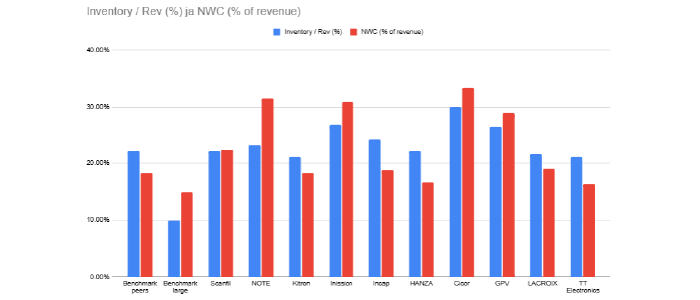
Figure 1. Inventory and net working capital percentage of revenue. © Agame
The NWC spectrum: The lean leaders
The three companies with the best net working capital efficiency below 20 % of revenue are Hanza, Kitron and Incap. Also, Lacroix and TT Electronics stood below 20%; however, this is following a significant clean-up and write-offs and remarkable losses in their discontinued business.
Looking a bit closer, it seems that Hanza and Incap have no indication of factoring or reverse factoring pumping up their NWC efficiency. Neither do they have a material amount of customer prepayments that would polish their numbers. Hanza and Incap can well be considered as the net working capital efficiency leaders.
Kitron’s €117M secret: How deposits can twist the data
Kitron, who has moved away from the use of factoring last year, has the most significant amount of customer deposits: a total of 117 M€ accounted in accounts payable / deposits received. Adjusting this, and taking only trade payables into account, the net working capital would increase to about 34 % of revenue. Understandably, the NWC is pulled higher by the strongest organic growth among the included companies. For this reason, I wouldn’t see it as a structural concern for Kitron, at least yet.
High NWC and factoring fans
NOTE, Inission, Cicor and GPV have the highest net working capital at around 30 %, and the organic growth is not the obvious reason as with Kitron. In addition, NOTE and GPV are also active in factoring. Factoring means selling their receivables to a third party and moving the factored portion from account receivables to short-term interest-bearing debt. Likewise, reverse factoring is about using a third party in payments to suppliers.
The factoring amounts are not explicitly stated, but based on the financial data it can be assumed that the magnitude is in the tens of millions of euros for both NOTE and GPV. This leaves room for capital efficiency improvement for all three.
Giant EMS benchmark
Finally, when comparing the mid-size European EMS companies with giant EMSs’ benchmark for inventory (~10 %) and net working capital (~15 %), it shows what the good looks like in low-mix / high-volume business. These are levels that high-mix low-volume players will likely not be able to sustainably achieve but it can be considered as a benchmark.
Do note that I made some adjustments to the giant EMSs' reference numbers for comparability, as some of them use rather aggressive factoring/reverse factoring as well.
Is there a sweet spot for Gearing?
Figure 2 is visualising how Gearing (Net Debt / Equity) is correlating with Return on Equity %. The graph shows that ROE% above 10% can be achieved in both net cash and high gearing positions. The drag of low gearing and excessive capitalisation is mainly visible with Incap, which has the second highest net profit (6.5 %) but is only number six in ROE% (10.4 %). TT Electronics and Lacroix “reboots” are shown as a dramatic negative impact on ROE% while Lacroix Gearing is clearly the highest *).
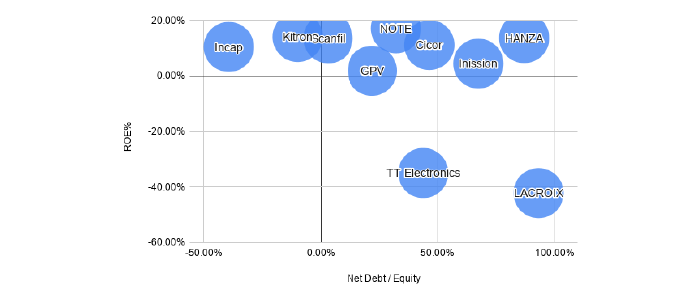
Figure 2. Correlation between Net Debt / Equity and Return on Equity
*) Note that the net debt calculations include IFRS 16 lease liabilities and acquisition related debt for comparability. Companies have various rules to calculate and present their net debt.
Let’s exclude the struggling TT Electronics and Lacroix under restructuring for a while. Looking closer at Inission and GPV who have the lowest ROE%, two stories are building up. Inission has a high rate of depreciation & amortizations and financials & taxes - a total 7.7 % of sales, while their EBITDA% of ~9% is lower than most of their peers’. GPVs low ROE% is primarily related to their EBITDA% (7.4 %), which is the lowest in the peer group.
NOTE stands out with the highest ROE% (17.1 %). This is contributed by the highest Net Profit (7.4 %) among the pack and their effective Net Debt / Equity % of 32.2 %.
Summary and Conclusions
Let’s finalise the analysis in three podiums: Profitability to owners, Working Capital Efficiency and Return on Equity
| Category | Gold | Silver | Bronze |
| Net Profit % | NOTE (7.4%) | Incap (6.5%) | Kitron (5.9%) |
| NWC Efficiency | Hanza (16.2%) | Kitron (18.3%) | Incap (18.8%) |
| Return on Equity | NOTE (17.1%) | Kitron (14.0%) | Hanza/Scanfil (~13.5%) |
Nordic leaders
Kitron is on the podium in all categories, with their low net working capital supported by the high customer deposits that we discussed earlier. Considering their outstanding growth driven by the defence and aerospace business, they stand out as the overall star among European EMS companies in current performance and potential.
NOTE stands out as the leader in both Net Profit and ROE%. They have one of the leanest Tax, Interest, Depreciation, and Amortisation (TIDA) rate (5.8%), but they tie a high amount of working capital in their supply chain. Their net working capital stands at almost 30 % of revenue. If they brought it on par with the benchmark, 35 M€ - 50 M€ of additional capital could be available to be injected in growth, acquisitions or dividends, or just to reduce the need for factoring arrangements.
Both Hanza and Incap have two podium positions. Hanza is the capital efficiency lead with Incap just slightly behind. Incap, being the leader in EBITDA%, will benefit from returning to lower tax rates as previous years. The high rate in 2025, to my understanding, is a function of Indian entity dividend policy and on the other hand retention policy of Estonian entity’s profits. In Estonia, companies are not paying income tax for retained or reinvested profits.
Most companies included in this analysis are healthy and in a position of an active player in the M&A game. The two companies undergoing transformation indicate that their continued business is healthy. The coming quarters and years will show if that will really be the case.
Predictable profitability through low-risk low-reward business model and conservative leverage ratio
Profitability of EMS companies is generally rather predictable. The EMS business model requires open book pricing, which prevents sustaining excessive margins, while on the other hand allows a part of the margin risk, i.e. sudden component price fluctuations, to be adjusted in the sales price. The EMSs need to focus on ensuring reasonable contract terms (i.e. for component price fluctuations, material obsolescence handling, liability clauses) with their customers, as well as on their own operational performance, cost efficiency and customer relationships.
EMS companies have comparably low leverage. One of the reasons is the need to buffer for net working capital fluctuations, and also additionally to be seen as a trusted partner with a resilient balance sheet that can handle exceptional circumstances. Customers are trusting one of their core processes to an EMS, and it must be in resilient hands.
EMS business has high net working capital requirements that can fluctuate fast. Among the medium-sized EMS players, the NWC % of revenue varies between 15 % and 30 %. The giant EMS companies with their fast-moving, high volumes stand between 10 % - 15 % and some go even lower with factoring. EMS companies are sitting on a big chunk of current assets up to 30 % of their annual revenue (inventory and account receivables) that they need to watch relentlessly in terms of obsolescence and customer bankruptcy risks.
The ROE% levels of the included medium-sized EMS companies (without ongoing business restructuring) vary between low single digit to above 17 %. The average and median values stand at slightly above 10 % - being a low-to-moderate profitability tier. Companies with ROE% below the cost of capital (typically 8 % - 10 %), need to improve in order not to destroy the shareholder value.
During Evertiq Expo Warsaw on October 22, 2026, Riku Hynninen will take the stage to present a financial benchmarking analysis of 10 leading European EMS companies. His presentation will explore how profitability is shaped by factors such as depreciation, interest and taxation, while also identifying which companies are best positioned for future M&A activity following recent industry consolidation.