
From inspiration to transformation: How Apator is building the factory of the future
There is a certain paradox in electronics manufacturing. The more processes become automated, the more important those that still rely on human expertise seem to be. These are often the very stages where the quality of the finished product is determined – at workstations where correct assembly still depends on the operator's experience, concentration and attention to detail.
At the same time, growing product complexity, increasingly demanding customer requirements and constant pressure to maintain the highest quality standards are forcing manufacturers to rethink how they organise their operations. And they must do so without compromising quality. Quite the opposite: the goal is to improve it even further.
It is hardly surprising, then, that manufacturers are increasingly exploring solutions based on artificial intelligence, alongside other forms of automation and production support. Yet the most interesting aspect is not necessarily the technology itself. What is far more revealing is how organisations arrive at the decision to implement it in the first place.
Discussions about AI tend to focus on return on investment, automation and cost reduction. Much less attention is paid to what implementing these technologies actually looks like in practice. What prompts a company to take the first step? What determines whether a project succeeds? And at what point does a technology cease to be an experiment and become an integral part of a factory's daily operations?
The story of Apator, a Polish manufacturer of metering devices and systems with a history dating back to 1949, illustrates that the answers to these questions begin to take shape long before a company invests in a new solution. In this case, it all started with a visit to another manufacturing facility.
Understanding the real needs is key
The Apator team visited another major Polish manufacturer, Fideltronik, at its facility in Sucha Beskidzka, to see how the company was using technologies to support electronics manufacturing. However, they did not arrive with a predefined list of requirements or a particular supplier in mind. The primary goal was to gain inspiration and compare their own experiences with the practices of another highly successful manufacturer.
As Sławomir Migała, Operations Director at Apator, explains in an interview with Evertiq, this approach is becoming increasingly essential.
"When exploring new areas of technology, you have to recognise that you cannot see every possibility from within your own factory. That is why we benchmark ourselves against others, look at best practices and assess how they might fit our own needs."
This observation captures a philosophy that ran throughout our conversation. In a world where technology is advancing faster than production management textbooks can keep up, competitive advantage increasingly belongs not to those who already have all the answers, but to those who know how to ask the right questions.
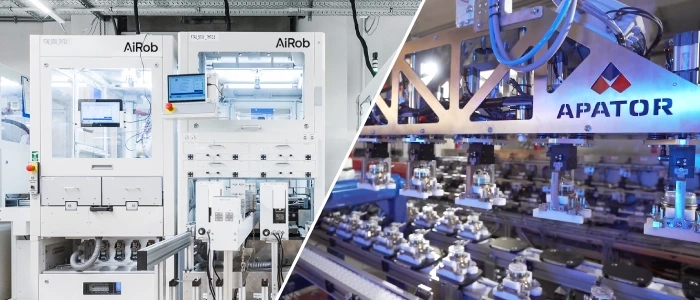
It was during the visit to Fideltronik that the Apator team came across a solution being implemented and further developed by another Polish company, AiRob. What caught their attention was not simply the fact that it used artificial intelligence, a technology now routinely presented as an essential part of modern manufacturing. The reason was far more practical.
"We were looking for solutions that would help our operators build quality into the process right at the workstation," Migała recalls. "We wanted a system that would be fast, require minimal involvement from our engineers, make it easy to create inspection plans and, at the same time, not compromise production throughput. When we saw the solution in action, we realised it addressed many of our needs."
That was the moment when technology stopped being an abstract concept and became a practical answer to specific manufacturing challenges.
The problem comes first, the technology second
It is easy to assume that AI adoption begins with enthusiasm for new technological possibilities, fuelled by the growing pressure on manufacturers to embrace artificial intelligence. Yet our conversation with Apator reveals quite the opposite.
For the Polish manufacturer, the starting point was not AI itself, but a specific operational challenge. In certain processes, Apator needed a more effective way to support operators during quality inspections. At the same time, not every process justified the expense of full automation or major modifications to existing production lines. And it is worth remembering that the products in question are highly sophisticated and sensitive.
Apator was therefore looking for a way to provide better support to operators during assembly, improve process reliability and reduce the risk of errors in areas where full automation simply did not make economic sense.
"We were looking for a solution that would help operators build quality into the product right at the workstation. We wanted something that would be easy to implement, require minimal engineering resources and, at the same time, not compromise production throughput."
One of the company's new production lines provides a particularly good example.
Given the existing production volumes, fully automating the line would not have been economically viable. However, the customer expected every unit to undergo automated checks to verify that all required components were present, within a clearly defined inspection scope.
"At our current production volumes, fully automating the line simply wouldn't make economic sense. But during an audit, the customer asked us a very specific question: 'How can you guarantee that every product is complete?' That was when we decided to install the system at every workstation. This allowed us to achieve 100% inspection coverage without making a major capital investment," explains Sławomir Migała.
This is where the distinction between implementing technology and solving problems becomes particularly clear. The team was not looking for the most advanced solution on the market. They were looking for a tool that would fit their existing production processes.
"We don't want to introduce isolated solutions. Our goal is to create a comprehensive system that supports production as a whole. We operate on a three-shift basis, often around the clock. We know that people's concentration levels fluctuate throughout the day. That is why we see this kind of support as a natural part of the production process."
This distinction matters. The objective was never to replace operators or diminish their role. Quite the opposite: it was to create a working environment that would help maintain consistently high quality standards, even in processes where full automation is either impractical or financially unjustifiable.
From inspiration to the first step
Returning from the visit, Apator did not rush into a large-scale rollout. Instead, the company began analysing which processes would genuinely benefit most from the new solution. The team also set out to identify where the technology could deliver the greatest value and which areas should be prioritised for the initial pilot. A dedicated team from AiRob worked closely with Apator to help answer these questions.
As Migała emphasises, the partner's expertise played an important role. AiRob went beyond simply supplying the technology, helping Apator identify the areas where implementation was most likely to deliver tangible results.
As a result, the first cameras were installed at seven production workstations. But this was only the beginning of the project. The greater challenge lay in determining whether the technology could become a natural part of everyday production operations.
The real question was no longer simply whether the system worked. It was whether the organisation could learn to make effective use of it.
The pilot project
The first few weeks after the system went live brought neither dramatic announcements nor decisions to expand the project immediately.
At Apator, the team understood that answers would take time. Rather than rushing into a large-scale rollout, the company opted for a pilot project. Working alongside AiRob, the team identified the areas where the solution could deliver the greatest value and installed the first workstations equipped with an image-based inspection system.
Over the following months, the project progressed steadily. The team monitored not only the system's performance but also how it was being used across different areas of production. Only by observing it over time could they determine whether the solution was genuinely becoming part of the production process or simply remaining another piece of equipment at the workstation.
After approximately a year, it was time to assess the results.
As Sławomir Migała recalls, this was when the team began to draw conclusions that would never have emerged from short-term testing.
"We had three main areas where the system had been implemented, and each developed somewhat differently. We saw that individual teams were using the solution in different ways and working at different paces. This showed us that we needed people who would take responsibility for standardising the solution across the organisation."
At first glance, this might seem like a purely organisational matter. In reality, it marked the beginning of the next phase of the project. The different experiences of individual teams demonstrated that further development would require common standards and clearly defined responsibilities.
"Today, we have a dedicated structure in place, with people responsible for developing and standardising the system. We are also seeing more and more new requirements and ideas for how the solution could be used. We don't want a series of standalone implementations. Our goal is to create a comprehensive system that supports production as a whole."
The project was thus beginning to move beyond individual implementations.
Perhaps the clearest indication of this shift was that new ideas were no longer coming exclusively from the team responsible for the project. Increasingly, production managers themselves were taking the initiative and proposing new applications for the technology.
This was arguably the real turning point, demonstrating that the system had begun to earn the trust of the wider organisation.
"Today, production managers come to us with their own ideas for further implementations. They can see the data, they can see the benefits, and they know which processes could gain the most from the solution. I think that's the best proof that the system has become a natural part of the way we work."
In many organisations, transformation is considered complete once a new technology is up and running. At Apator, however, that was only the beginning.
Good technology unlocks human potential
Although the initial goal of the implementation was to support quality inspection, over time Apator began to recognise the solution's much broader impact. In certain processes, the company had identified a risk of products leaving assembly incomplete, which needed to be addressed directly at the workstation. It became increasingly clear that the technology was also changing how people could make use of their time and expertise.
This is an aspect that receives relatively little attention in discussions about artificial intelligence, even though it was one of the original promises of the technology: to help people realise their full potential.
In many manufacturing companies, quality issues are addressed through additional training, new work instructions, changes to workstation layouts or modifications to product design. Each of these measures requires time, resources and the involvement of skilled personnel.
According to Sławomir Migała, advances in operator-assistance technologies are now making it possible to approach these challenges differently.
"In the past, whenever a quality issue arose, we would consider whether to provide additional operator training, revise the work instructions or redesign the product to eliminate the possibility of error. But all these measures take time and require the involvement of specialists. Today, we can resolve some of these issues much more quickly."
By taking over repetitive inspection tasks, the technology allows engineers and quality specialists to focus their expertise where it can deliver the greatest value.
"This allows us to devote more time to tasks that genuinely require knowledge and experience. Instead of focusing on recurring problems, we can work on improving our processes, analysing data and developing further improvements."
This approach aligns closely with the philosophy of continuous process improvement. Consistent quality control is not an end in itself. It provides the foundation on which an organisation can build the next stages of its development.
As Migała emphasises in our conversation, this is precisely why the project was viewed as a long-term investment from the outset.
"We don't want to develop individual solutions to individual problems. Our goal is to build an environment that will support our manufacturing operations, regardless of how our processes evolve."
A digital pair of eyes
One of the most interesting findings to emerge from the implementation was the system's impact on operators' day-to-day work.
Today, discussions about artificial intelligence often revolve around whether new technologies will replace human workers and how much financial value they can generate. At Apator, however, the conversation took a different direction from the outset. The question was how technology could help people perform their jobs with greater confidence, less stress and a lighter workload.
It is in this context that Migała describes the system as a "digital pair of eyes".
"No one can maintain the same level of concentration throughout an eight-hour shift. That's perfectly natural. So we see this system as an extra pair of eyes, supporting operators and helping them catch potential mistakes before a product leaves the workstation."
This approach also changes the way quality inspection is perceived. Traditionally, errors are often detected only at the end of the production process, when correcting them means additional work, delays or reworking a finished product. Here, corrective action can be taken immediately, with operators receiving feedback at the very moment they are performing the task.

As Piotr Owczarek, CEO of AiRob, explains, this immediate feedback is precisely what sets the solution apart from traditional quality inspection.
"If the system detects a missing component or another non-conformity, the operator can correct it straight away. There's no need to wait for final quality inspection or investigate a customer complaint. The problem is resolved right where it occurs," Owczarek explains.
Over time, this began to influence not only process quality but also the working environment and the atmosphere on the production floor.
"What mattered a great deal to me was that operators stopped seeing quality inspection as an assessment of their own performance. There's no inspector or auditor standing over their shoulder. Instead, they have a tool that helps them do the job correctly. That really changes the way people think about quality."
AiRob has observed similar effects in other implementations.
"On several occasions, operators have told us that the solution simply makes their work less stressful. They know that if they overlook something, the system will flag it immediately. That gives them a real sense of reassurance."
This is one of those benefits that is difficult to capture in a spreadsheet, yet can have a profound impact on both workplace culture and the quality of work across an entire team.
A Solution That Evolves with the Organisation
In many projects, getting a system up and running effectively marks the end of the implementation process. The customer receives a ready-made tool, and any subsequent development takes place largely independently of the facility where it is being used. In the case of Apator and AiRob, however, the experience gained on the production floor has become a driving force behind the continued development of the solution itself.
As Piotr Owczarek points out, every manufacturing facility brings its own requirements and production characteristics to the process.
"Every customer works a little differently, and every manufacturing operation has its own specific requirements. Of course, we come in with an existing solution, but it quickly becomes apparent that certain processes call for new features or a different approach. And that's when the most interesting part of our work begins."
A good example is the range of features that may now seem like obvious elements of the system but were actually introduced in response to requirements identified during successive implementations.
"Initially, the system couldn't read QR codes or text. It was our customers who showed us that these capabilities were needed in their processes. With each new implementation, the system gradually evolved."
Sławomir Migała sees the partnership in much the same way. When discussing AiRob, he places particular emphasis on the team's willingness to understand Apator's production processes and work together to find solutions.
"What really matters to me is that we're working with people who genuinely want to understand our manufacturing operations. They don't arrive assuming they already have all the answers. They listen first, then propose solutions, and work alongside us to see how those solutions perform in practice."
In this model, production processes are not forced to adapt to the limitations of an off-the-shelf tool. Instead, new requirements emerging on the production floor become the starting point for further development of the system.
Putting data to work
Initially, the system was primarily intended to support operators and assist with quality inspection. Over time, however, its role began to extend well beyond verifying assembly accuracy. Increasingly, it was not just the inspection results that mattered, but also the data the system collected. Each product, every operation performed, every correction made and every successful inspection provides only limited insight on its own. Taken together, however, these records build a detailed picture of the entire production process.
"Today, we see this solution from a much broader perspective. It's no longer just a quality inspection system. It has become another valuable source of information about our processes. The more we know about what's happening on the production floor, the easier it becomes to make informed decisions about future improvements," says Sławomir Migała.
For Piotr Owczarek, this represents one of the most natural directions in which such technologies can evolve.
"Every operation leaves a trace. We can go back to a product manufactured several months ago and reconstruct its entire assembly process. We can see who performed each operation, where non-conformities occurred and how they were resolved. This opens up entirely new possibilities for process analysis."
For Apator, this means being able to make decisions based on actual production data rather than relying solely on observations or isolated incidents. And it is precisely this kind of foundation that makes the next stages of digital transformation possible.
A true partnership
One of the things that stood out most during our conversation was the way both companies spoke about their collaboration. There was little sense of a traditional supplier-customer relationship. Instead, they described a shared journey in which both the technology and the organisation using it continued to evolve.
This approach was evident from the very beginning of the project. Before committing to a wider rollout, Apator had the opportunity to test the technology in a real production environment. This reflects AiRob's broader approach to working with customers. Rather than relying on sales presentations or demonstrations conducted under controlled laboratory conditions, the company prefers to put its technology to the test on the production floor. For both parties, what mattered was whether the solution could meet the demands of specific processes and overcome real manufacturing challenges.
"We don't want to convince customers with presentations or brochures alone. We'd rather demonstrate our solutions in the environment where they will actually be used. Only then can you properly assess whether they will deliver the expected results," explains Piotr Owczarek.
For AiRob, a pilot project is not simply an opportunity to evaluate an existing product in a particular production environment. It is also a chance to further develop the technology itself.
"Every implementation teaches us something. Customers introduce us to processes we haven't encountered before. And it's often during these projects that ideas for new features or improvements to the system emerge."
A good example is the range of features that may seem obvious today but were not part of the earliest versions of the solution.
"Initially, our system couldn't read QR codes or text. It was our customers who showed us that these capabilities were needed in their processes. That's how we came to develop additional modules for the system."
In practice, this means that the development of the solution does not end once it has been implemented. Quite the opposite: implementation marks the beginning of a new phase, one that helps shape the direction of future development.
This is precisely the kind of partnership that Apator particularly values.
"What really matters to me is having people on the other side who want to solve problems together with us. They don't arrive with a ready-made answer to every question. They first take the time to understand the process and only then propose the right solution," emphasises Sławomir Migała.
This approach reflects the philosophy behind the entire project. The aim was never simply to introduce another tool, but to build a solution capable of evolving alongside the organisation itself. And isn't that exactly what a true partnership in modern manufacturing should be about?