



Evertiq Expo Lund: Strategies, security and the hardware Europe is missing
Factories are being built, strategies are being written and investments are being made at a pace the electronics industry has not seen in decades. What is actually happening — and what is still missing — is the theme of this year's Expo in Lund.
Behind the investments and the strategies, however, are questions that are rarely asked as directly: what is missing, who is building it, and what happens if Europe fails to act?
Vytautas Ilgūnas of TLT PCB has an answer to at least one of them. AI systems are fundamentally dependent on advanced PCBs — multilayer designs, HDI solutions, high-reliability manufacturing — and that capacity largely exists outside Europe today. His argument is straightforward: without a rebuilt domestic PCB industry, European AI sovereignty is an illusion. Ilgūnas will address the structural gaps in Europe's electronics ecosystem from the stage and what rebuilding advanced PCB manufacturing actually means in practical terms.
Running in parallel with the hardware question is another: what Sweden actually has to offer in this landscape. Elisabet Österlund and Malin Berglund of Semiconductor Sweden will present the mapping that forms the basis of Sweden's national semiconductor strategy 2035. Six months of roundtable discussions and workshops have produced a comprehensive picture of an ecosystem most people underestimate. More than 8,000 Swedish companies, employing 260,000 people and generating revenues exceeding SEK 1,000 billion, are directly dependent on advanced electronics and semiconductor technology. The mapping shows where that capacity actually sits — from global industrial players to niche companies and startups — and where the strategy believes Sweden can take global leadership.
If Österlund and Berglund show the strength of the ecosystem, Mahdi Fazeli, Associate Professor in hardware security at Halmstad University, shows its vulnerability. Hardware trojans — malicious modifications embedded in circuits during design, fabrication or assembly — are a threat that exists precisely because supply chains are global and distributed. Fazeli maps how the threat landscape has evolved as third-party licensed IP has become the norm, and what this means for how the industry needs to approach hardware integrity going forward.
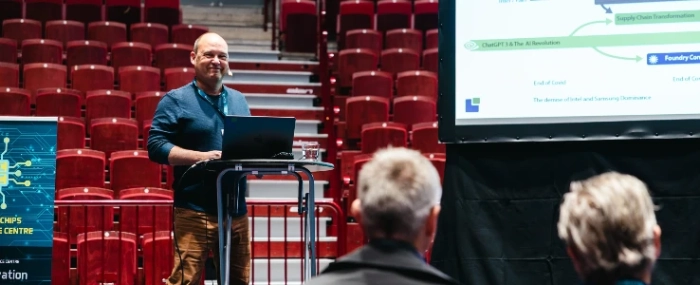
For those who want to step back and view the industry as a whole, Claus Aasholm, founder of Semiconductor Business Intelligence, will spend an hour examining the semiconductor market as it actually looks — not as it is presented. That means capacity expansion, capital flows, real utilisation patterns and regional policy effects, analysed against data rather than industry consensus. In a field where the narrative often runs ahead of reality, it is a necessary recalibration.
The rest of the programme covers the practical side of the industry: component embedding, energy recovery in semiconductor manufacturing, and obsolescence management. Dennis Dahlgren of Evertiq closes with a mapping of Sweden's 20 largest EMS providers.