


Infineon opens backend site in Bangkok with room for five modules
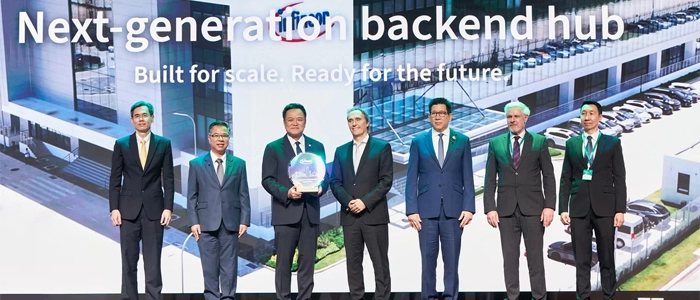
Infineon Technologies has inaugurated a new backend manufacturing site in Samut Prakan, Bangkok. The site currently has one module but is designed to grow to five, which could make it one of Infineon's largest backend sites over time.
The site has around 350 employees today, and that number is expected to rise to approximately 1,000 as the first building – Module A – ramps up, according to a press release from Infineon. It covers the full range of backend processes, including assembly and test as well as wafer test. Production will serve automotive, industrial and energy infrastructure applications.
Infineon presents the investment as part of an effort to diversify its global manufacturing network and add capacity for long-term demand growth. The site will complement the ongoing expansion of the company's frontend capacity.
When Infineon broke ground in January 2025, the company said the site would be essential to meet growing demand for power modules, driven by industrial applications and renewables. At the time, it planned for the first building to be ready for operations at the beginning of 2026, with further ramp-up to be managed in line with market demand.
"We are establishing a new hub in the heart of Southeast Asia, surrounded by a fast-growing ecosystem and with excellent access to global logistics. This helps us further diversify our manufacturing network across regions and serve our customers with resilient capacity and great flexibility," says Alexander Gorski, Chief Operations Officer of Infineon Technologies.
The site was inaugurated together with Thailand's Prime Minister, Anutin Charnvirakul, who described the investment as a vote of confidence in Thailand as a semiconductor location. The site was built as a greenfield project. It runs on renewable electricity and has systems for water recycling and rainwater collection.
Infineon has not disclosed the size of the investment, either at the groundbreaking or now, nor the site's production capacity or a timeline for the remaining four modules.