
Open Innovation Meets the Factory: Industrialization Support’s Missing Link in Electronics
One answer taking shape is to focus on Value Engineering combining artificial intelligence tools and human intelligence and experience. Finally bringing startups and manufacturers together before a product is designed, generates cross fertilization of new ideas that may help traditional companies to reposition themselves. At electronica 2026, Italy’s Elemaster is putting that model on the show floor.
An industry changing its centre of gravity
For decades, European electronics took its rhythm from automotive and a handful of traditional sectors. That anchor is loosening. Energy efficiency, data centres and humanoid robotics are pulling demand elsewhere, a change that Giovanni Cogliati, Vice President & Chief Commercial Officer at Elemaster Group Electronic Technologies, reads as structural rather than cyclical:
“The whole European market has to reposition itself, adding new business fields to the current industry driven mainly by automotive and traditional sectors. Energy efficiency, data centres, humanoid robotics: it is an epochal shift, perhaps towards a new industrial revolution that will last the next ten years, maybe more.”
The EMS sector is not simply growing; it is repositioning, and with it also the service provided needs to evolve in a new value proposition aimed to face the actual challenges. Elemaster resumes this scope as VALUE ENGINEERING.
A bottleneck ideas alone cannot solve
The shift is happening while the supply chain is under strain. Memories, multilayer ceramic capacitors (MLCCs) and printed circuit boards (PCBs) are all in short supply, and AI is a major driver. According to eeNews Europe, AI servers use ten to fifteen times as many MLCCs as general-purpose ones, with lead times beyond 20 weeks on high-capacitance parts and passive component prices up 10-15% on average. TrendForce expects DRAM supply to stay tight through 2027, as HBM absorbs wafer capacity.
Elemaster’s own response is to help customers identifying smart solutions to overcome shortages and obsolescence issues. The combination of advanced artificial intelligence engineering tools and 50 years of human intelligence is the key advantage Elemaster’s Value Engineering team can bring to customers.
Everything starts from a sharp analysis of the product evaluating the Design For Manufacturability and Design For Testability. These steps are not enough today as needs to be combined with Design for Supply Chain: a deep analysis of the life status of the entire bill of materials aimed to identify single source components, obsolete or very mature components and long lead time items well in advance.
Once the criticalities are spotlighted the Component Engineering Team take the responsibility to identify any existing pin to pin alternative on the market and proposing them to the customer for validation.
In case there is not the possibility to identify alternatives the simpler solution is to make stock of the critical components, but this is not always possible and in any case is just temporarily solving the issue while consuming cash in stockpile.
The smarter solution is coming from the Value Engineering proposition that is aimed to identify the best redesign that affect the least the current one, bring more cost competitiveness, assure better sustainability of the supply chain and, why not, may add new features to the product helping the customer to gain shares of its market.
Finally all the redesign process is also well supported by the possibility to manufacture in house PCBs with trough a dedicated factory located in the same industrial compound able to provide complex multilayers in a quick turn around time: a unique capability within the European EMS landscape that in the current scenario bring a clear competitive advantage.
Why startups and manufacturers need each other
There is no direct technical line from a startup’s product to a capacitor shortage, and nobody pretends otherwise. What connects them is a method: when conditions are hard, solutions tend to come from looking at the problem differently, often from outside the usual circle of suppliers and customers.
Startups bring unconventional ideas but rarely the knowledge to make them at scale: what a product will cost to manufacture, which supply constraints will surface later, which compromises made on paper will weigh on margins. Established manufacturers have the opposite profile, with process depth, supply chain reach and multinational customers, but fewer chances to see what is coming.
Elevo Innovation Hub, the initiative launched in October 2025 to help young companies industrialise their ideas, steps in at the architectural phase, while decisions that fix production costs are still open, and works on a break-even basis without taking equity stakes. The return runs both ways: startups get industrial realism early, while the manufacturer gains innovation scouting for its customers and a channel for cross-fertilising ideas between standard industry and young companies.
The model on the show floor
At electronica 2026 (Messe München, 10 to 13 November), Elemaster shows the idea in physical form for the first time. Its stand has two areas: the Group’s traditional services, from PCB manufacturing to assembly, testing and design, and a space for four startups. One of them will announce the closing of an investment round on the eve of the fair.
Taken together, they cover several of the themes above. Coera develops “Intelligent Safety” software that lets robots perceive people and adapt to them, a precondition for sharing workspaces. Novac makes lithium-free, solid-state supercapacitors that it says can withstand up to one million charge cycles. Mawip builds hybrid acoustic and MIDI-capable wind instruments, a demanding exercise in miniaturization far from the usual trade-show fare. Levitology designs tailor-made levitation systems for product display.
A strategic bet for a contract manufacturer
For nearly fifty years, Elemaster, an international engineering and manufacturing group headquartered in Italy with sites in eight countries across four continents, has acted as contract manufacturer. Bringing new value engineering services to overcome supply chain constrains and supporting startups at the industrialization stage are ways to move from executor to technological partner for well established multinational companies and new comers scaling the markets.
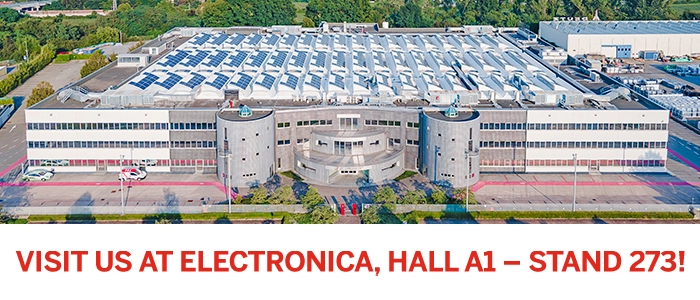
Visit Elemaster at electronica. Find them at Stand 273, Hall A1.