
Overview of Display Elektronik's Offer
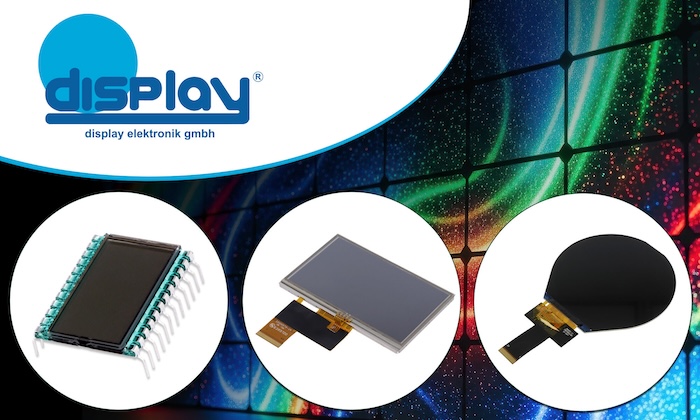
Below we present an overview of displays by Display Elektronik. This is a German supplier specializing in this narrow field of optoelectronics for over 40 years. Through TME (directly from our warehouses), you can purchase many of the company's solutions, including LCD, TFT, and e-paper displays. In this article, we present a general overview of these modules and their potential applications. Overall, it should be noted that these are high-quality products from the portfolio of a well-known European brand. Moreover, they should be classified as affordable solutions, making them additionally attractive. We invite you to explore the offer!
In this article, we cover topics such as:
- Color displays with high resolutions
- Affordable, classic LCD models
- Versatile, monochrome OLED modules
- Other product groups in the supplier's offer
- Applications of e-paper technology in miniaturized electronics
- LED backlighting modules for LCD displays
TFT Displays
Let's start the overview of Display Elektronik's offer with the supplier's most advanced solutions, namely displays with TFT matrices, capable of displaying multicolor images. Moreover, a significant portion of the offered solutions is made in the popular IPS technology (In-Plane Switching), which allows for displays with excellent resolution, density, and wide viewing angles. In the case of Display Elektronik products, resolutions reach FullHD class, i.e., 1920x1080 pixels (in some models 2560x720 pixels). The matrices can have a diagonal from 0.96 to 16.7 inches.
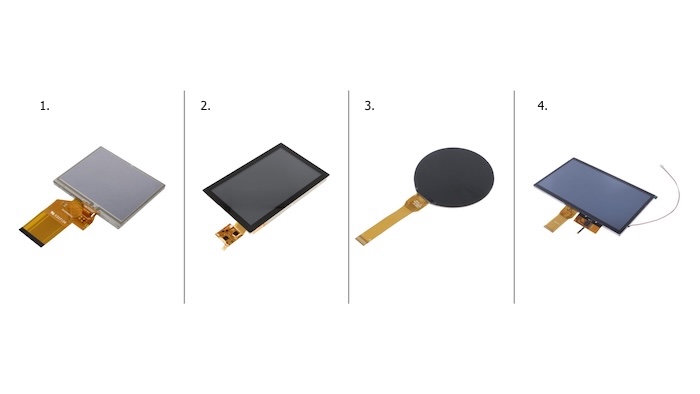
The range of TFT displays consists of a palette of solutions adapted for various HMI interfaces. Customers will find, for example, miniature models, round and rectangular versions with unusual proportions (narrow, panoramic). For constructing HMI circuits, versions with touch panels – resistive and more precise capacitive ones – are also available. Designers will surely appreciate the diversity of the offer in terms of controllers and interfaces used (LVDS, MIPI, RGB, parallel, etc.). Some products are adapted to work with Raspberry Pi computers.
It is worth noting that selected versions of the elements can operate in a very wide temperature range (e.g., from -30°C to 80°C), allowing their use in devices mounted outside buildings (ticket machines, vending machines, etc.).
LCD Displays
Although the capabilities of TFT/IPS matrices are very broad, ordinary, monochrome LCD displays continue to enjoy undiminished popularity. Here, three main subgroups can be distinguished: those adapted to display only numbers or letters (using 7-segment sets), most often operated via a parallel interface; well-known alphanumeric models, successfully used for decades; and graphic versions. The latter two types may have classic interfaces (e.g., 8-bit HD44780 controller input) or more advanced controllers adapted for connection using serial buses like SPI or I2C.
Display Elektronik offers alphanumeric versions with layouts from 8x1 to 40x4 characters, with positive or negative matrices, with various backlight colors (even in RGB versions), supporting different alphabets: Latin, Japanese, Cyrillic.
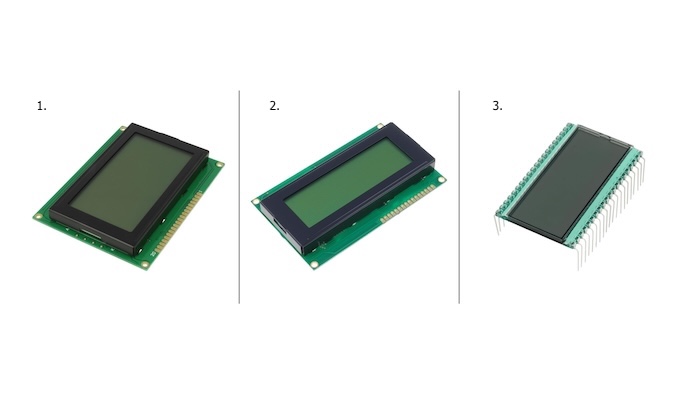
Among graphic displays, there is similar diversity. They have diagonals from 1.2 inches to 5.7 inches and resolutions from 120x64 to 320x240. Various controllers and interfaces are used in them. Selected models have a resistive touch panel.
Alphanumeric and graphic modules have leads made in the form of soldering fields (with the possibility of soldering pin connectors with a 2.54mm pitch) or on an FFC/FPC ribbon. In the case of digital displays, mounting is done using THT technology.
OLED Displays
In the OLED models offer, there is a division similar to the above-described assortment – with the difference that there are no digital versions here. OLED displays do not require backlighting, making them more energy-efficient, and their matrices often have higher pixel density. This is evident in the case of graphic variants, which in Display Elektronik's offer can have a diagonal of just 0.49 inches. Most products are equipped with popular controllers (like SSD1306, SSD1309) along with systems enabling their operation via SPI or I2C interfaces.
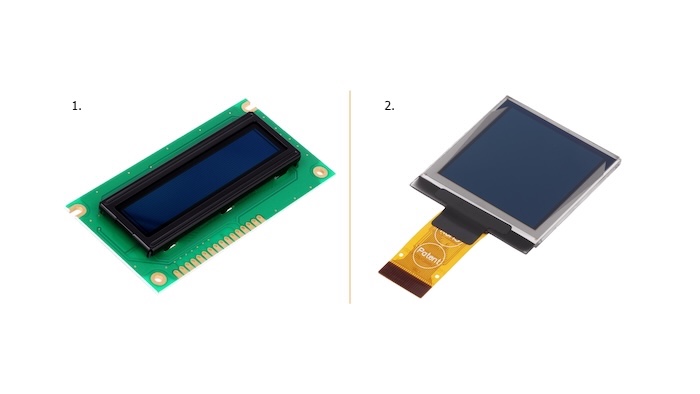
Alphanumeric models are designed to be equivalent to LCD displays. They even have controllers compatible with the HD44780 interface, similar inputs, and supply voltage ranges (4.8…5.3V DC). From the TME catalog, you can order versions of various sizes: from 8x2 to 40x2 layout with character heights from 2.84mm to 8.9mm.
Other Display Elektronik Products
Apart from the above solutions, which form the core of the manufacturer's portfolio, the supplier also offers several other noteworthy solutions in the field of displays.
E-paper
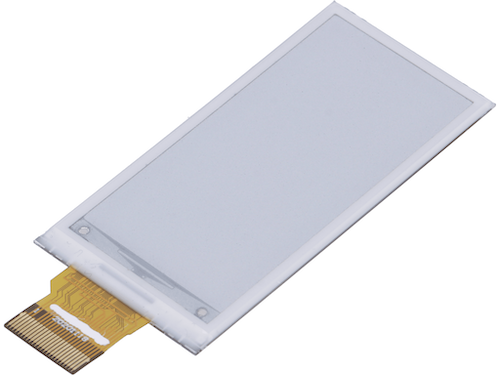
E-paper displays have many applications – thanks to being perceived by the human eye as the most natural, but also due to their immense energy efficiency. They are used, of course, in ebook readers – and smaller modules are often found as price tags or reusable identifiers, panels of miniature weather stations, home controllers (smart home), in IoT devices and many others. These types of displays require a supply voltage of 2.6…3.7V and can be operated using SPI, a typical interface for microcontroller systems. They are therefore simple to implement. Display Elektronik's offer includes models with diagonals from 2.13 inches to 6 inches, in resolutions from 122x250 to 758x1024.
Backlighting
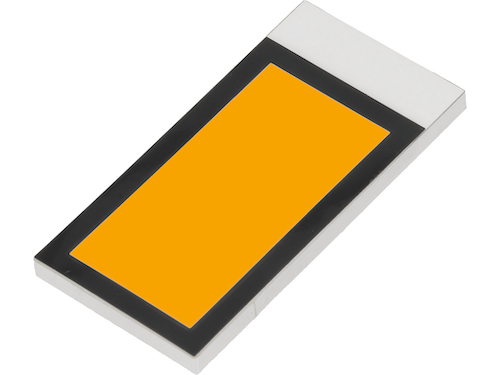
Backlight modules are backlighting for LCD displays. After installation (or replacement), good readability of the screen is achieved even in very poor lighting conditions. Background replacement is sometimes done to adapt the display color to the overall aesthetics of a given device. The surface of the elements emits light with uniform intensity across the entire surface. The assortment includes white, amber, red, blue, yellow-green versions, and RGB type (capable of imitating any color). Products are available in a wide range of brightness: from 25cd/m2 to 1800cd/m2.