




AI is splitting the PCB industry in two, says Yole
The PCB industry ended 2025 with revenue of about USD 88 billion and is forecast to reach USD 140 billion by 2031, an average annual growth rate of 8%. But according to Yole Group, that average hides two industries moving in opposite directions: an AI segment growing by 45 to 70% a year, and a commodity segment that is barely growing at all.
AI-grade boards and materials account for about 30% of the market today, and are expected to make up more than half by 2031, according to a press release from Yole Group on its new report, The Printed Circuit Board (PCB) Industry 2026. The split shows up at every level. Boards with 18 or more layers are expected to grow by 15.7% a year through 2031, while 4- to 6-layer boards grow by 2.3%. Since 2020, servers and data centres have risen from 16% to 25% of PCB demand, overtaking consumer electronics.
The driver is value per system rather than unit volume. According to Yole, PCB content per Nvidia rack increases by more than 200% in the new generations, including Vera Rubin, and 57% of the increase comes from board categories that didn’t exist a generation ago. A custom accelerator carries roughly twice as much PCB content as a GPU.
“The industry average is the least useful number in this market. One half is compounding at 45 to 70% a year, the other is barely growing,” says Bilal Hachemi, Senior Technology & Market Analyst at Yole Group.
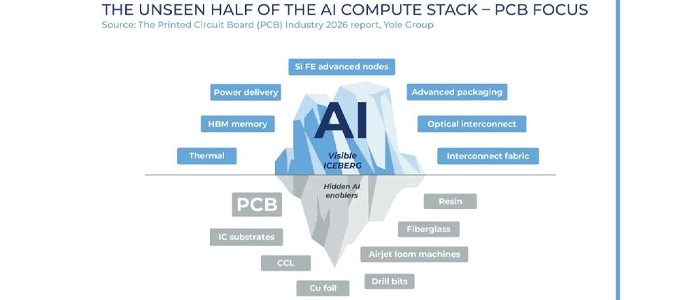
The shift is also reaching further up the supply chain. Yole expects the laminate market to double to USD 46 billion as AI-grade materials displace standard ones. CCL now advances one generation every 18 to 24 months: M7 for Nvidia's GB300, M8 for Vera Rubin, M9 for Rubin Ultra in the second half of 2027 and M10 for the Feynman generation. Each step changes all four constituent materials, and M9 laminate sells at four times the price of M7.
That’s why Yole talks about the “semiconductorisation” of PCBs. Boards now compete on line width, loss tangent and via aspect ratio, and at 224 Gb/s even the roughness of the copper becomes a source of signal loss.
Automotive is the second, and more durable, growth driver. Yole expects it to grow by 14% a year to more than USD 23 billion in 2031. Boards for EV powertrains are growing by 30% a year and ADAS central compute by 46%, while content for combustion engine vehicles shrinks by 15% a year. According to Yole, automotive will keep demand for high-end HDI going after hyperscaler capex normalises.