



Ericsson turns mobile networks into drone detection systems
Ericsson has launched a system that uses the mobile network to detect and track drones, including those that aren’t connected to the network. The first small-scale, sensing-only commercial pilots are expected to start in 2027, with wider deployments from 2028.
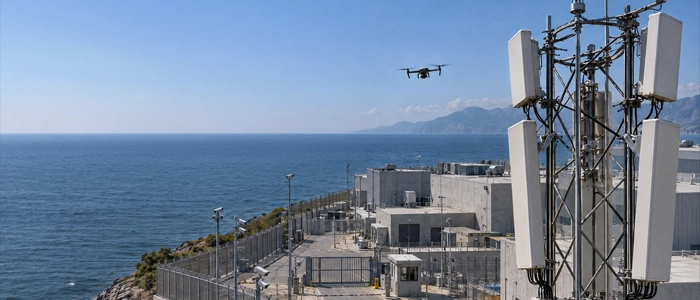
The Ericsson Integrated Sensing and Communication (ISAC) System uses sensing-capable 5G radios to analyse how radio signals are reflected by objects in the environment, according to a press release from Ericsson. Signals are transmitted and received across several geographically separate mobile network sites at once, so that an object can be seen from multiple angles. According to Ericsson, this improves positioning accuracy and makes it easier to keep track of an object across the whole coverage area.
The system is aimed at a growing problem. Small, low-cost drones are increasingly used for unlawful surveillance, organised crime, sabotage and warfare, and they’re hard to detect at low altitude. Dedicated sensors such as radar are expensive to roll out over large areas. Ericsson therefore positions the system as a complement to radar and other sensors rather than a replacement, built on towers, backhaul and spectrum that are already in place.
In tests, the system has detected and tracked micro drones at distances of several kilometres, with precise 3D positioning, according to Ericsson. It has been trialled on live 5G networks with AT&T in Arlington, Texas, and with Erillisverkot in Helsinki, Finland. In Poland, Ericsson, operator Play and Asseco combined the technology with Asseco’s acoustic drone detection system.
The Swedish Armed Forces is among those following the technology.
“Detecting small drones across large areas is a growing operational challenge. The possibility of using distributed infrastructure to complement existing sensors could provide an important additional layer of situational awareness,” says Carl Lundqvist, Chief Architect at Swedish Armed Forces HQ.
The integrated communications capability, the “C” in ISAC, will be added as the system evolves towards 6G.