




Rising component costs could push notebook shipments lower in 2027
Next year, the biggest challenge for the notebook market is no longer getting hold of components but whether consumers are willing to pay for them, according to TrendForce. Global shipments are projected to decline, and the drop could be considerably steeper if brands pass on the full cost increase.
TrendForce currently expects global notebook shipments to fall by a low-single-digit percentage in 2027, according to a press release from the market research firm. If DRAM and CPU prices remain elevated and brands pass more of the cost on to consumers, higher retail prices could lengthen replacement cycles further and push the decline into the high-single-digit range.
The 2026 figures paint a better picture than the underlying market. Shipments this year have been supported by improved CPU availability, early procurement by brands and replacement purchases brought forward. TrendForce does not see this as a real recovery in end demand. Some of the purchases originally expected in the second half of 2026 and beyond have already been made, which is likely to weaken replacement demand going forward. As cheaper inventory runs out, brands will also feel the rising prices of CPUs, DRAM and SSDs more directly.
The scale of the problem shows in the bill of materials. In a mainstream notebook with a suggested retail price of USD 900, the CPU, DRAM and SSD accounted for around 68% of the BOM cost in the third quarter of 2026. That leaves brands with three options, none of them painless. They can raise prices and risk weaker demand, absorb the costs and squeeze their gross margins, or cut specifications such as memory capacity and make their products less competitive. According to TrendForce, brands are unlikely to be able to hold on to pricing, specifications and profitability all at once in 2027.
The cost pressure could also reverse some of the production shifts the industry has made in recent years. If tariff pressure does not increase further, TrendForce expects production costs, supply chain completeness and operational efficiency to weigh more heavily than geopolitical risk when brands decide where to manufacture.
The extra costs of logistics, component sourcing and supply chain management in newer manufacturing locations are coming under greater scrutiny, which could lead brands to move some capacity back to China.
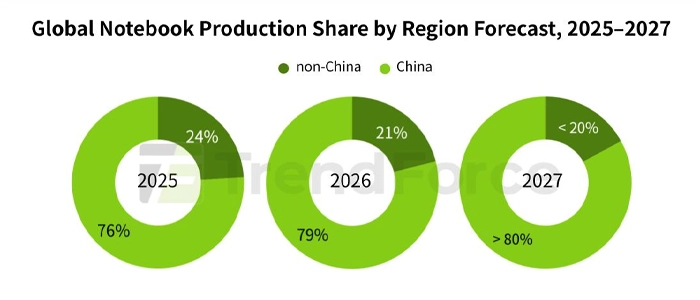
TrendForce estimates that the share of global notebook production outside China will fall from around 24% in 2025 to 21% in 2026, and could drop below 20% in 2027.
On the component side, supply is expected to become more uneven. DRAM is likely to remain tight as AI servers continue to absorb advanced process capacity, while supply growth for PC DRAM risks remaining limited. NAND Flash constraints, on the other hand, could ease in the second half of 2027 as new capacity comes online. PCBs, MLCCs and PMICs are also under pressure from capacity allocation, raw material costs and geopolitical factors, which could mean higher prices or longer lead times.