



Bypassing weak cells could add to EV battery life
Batteries that can bypass weak cells could keep electric vehicles on the road longer and lower the total cost over the battery's lifetime, a study led by Chalmers University of Technology suggests. Under optimal conditions, the lifespan increases by more than 20%.
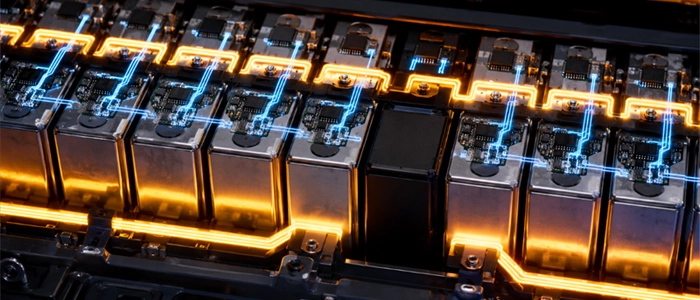
An EV battery pack consists of many interconnected cells that do not age at the same rate. In today's packs, the weakest cell sets the limit for the entire pack, even when the other cells still have capacity to spare. According to a press release from Chalmers University of Technology, the researchers have mapped the benefits of reconfigurable battery packs, where switches and control systems change the connections between cells so that weaker ones can be bypassed.
Albert Škegro, a doctoral student at the Department of Electrical Engineering at Chalmers and first author of the study, compares today's packs to cells tied together with a rope, all trying to move forward.
"Since they are bound to each other, everyone has to keep the same pace as the slowest cell and stop when that cell stops. With the solution in our study, the battery can instead bypass the cell that is causing problems and continue forward," he says.
In the researchers' models, the most advanced solution – where each cell can be controlled separately – can extend the lifespan by over 20% in some high-voltage vehicles, such as electric trucks and long-range electric cars. In practice, groups of cells are more likely to be controlled together, which makes the figure a theoretical upper limit.
"Reconfiguration is not a question of 'on or off'. It is a spectrum, and where a manufacturer chooses to sit on that spectrum determines how much of the potential benefit can be realised," says Changfu Zou, Professor at the Department of Electrical Engineering at Chalmers and co-author of the study.
To show what this means in practice, the researchers modelled a typical 80 kWh car battery with an annual mileage of 12,000 kilometres. A conventional pack is assumed to be replaced after 10 years, in line with current industry practice. The reconfigurable pack reached the same point after about 11 years, roughly 14 months later, and it also had a higher residual value because it had aged less.
The extra electronics make the technology more expensive up front. According to the researchers, however, the longer service life and higher residual value can outweigh that additional cost under many realistic conditions. The potential is greatest in high-voltage, long-range vehicles with many series-connected cells.
The approach could also affect battery manufacturing. Today, considerable resources go into testing and matching cells with similar characteristics. Because a reconfigurable pack tolerates greater variation between cells, the need for that kind of precise matching could fall. More packs could also get a second life, for example as stationary energy storage.