




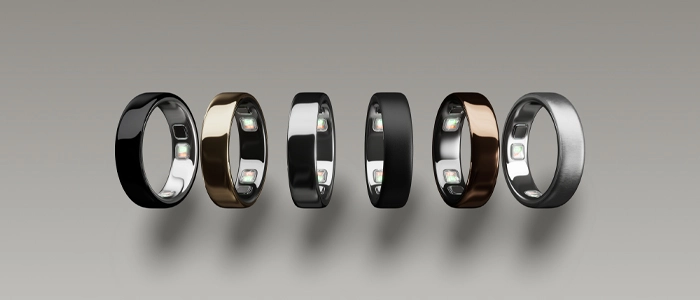
Oura faces lawsuit over sleep tracking accuracy claims
Finnish smart ring maker Oura is facing a proposed class action lawsuit filed in a US federal court on August 20 by California law firm Clarkson Law Firm. The lawsuit alleges that the company's marketing claims about its sleep tracking capabilities are false and misleading.
The complaint alleges that Oura marketed its rings – which are priced at USD 300 and upwards – with claims of "Unparalleled Accuracy" and "95% Sleep Staging Accuracy compared to clinical sleep lab," while the rings are physically incapable of measuring sleep stages with clinical precision. Sleep staging requires electrodes on the scalp, leads on the eyes and sensors on the chin to measure brain electrical activity, eye movements and muscle tone – none of which an Oura ring can do.
Instead, the ring uses indirect proxies such as heart rate, blood oxygen levels and movement, with AI models estimating which sleep stage the wearer is in. The lawsuit characterises this as "guesswork" sold as reliable science.
The suit also points to what it describes as an internal contradiction. Oura's own technical documentation states that using the ring "is not the same as a polysomnography sleep study" because it "does not measure electrical brain activity or eye movements" – a statement the lawsuit argues directly contradicts Oura's marketing claim that the ring "achieves 79% agreement with gold-standard polysomnography" and is "an alternative to PSG Sleep Studies."
In a statement to TechCrunch, Oura rejected the allegations. "We stand behind our science, research, and accuracy claims. Like other consumer sleep wearables, Oura Ring estimates sleep stages using multiple physiological signals, including heart rate, heart rate variability, movement, breathing patterns, and temperature," a company spokesperson said.
Oura points to independent studies validating its accuracy claims, while noting that the ring is not a medical device and is not a substitute for a clinical sleep study.
The lawsuit seeks compensation for consumers who purchased the product based on the allegedly false claims, and calls on Oura to stop its misleading marketing. The allegations have not been tested in court.