


AI data centres are consuming PCBs – Chinese lead times stretch to 2028
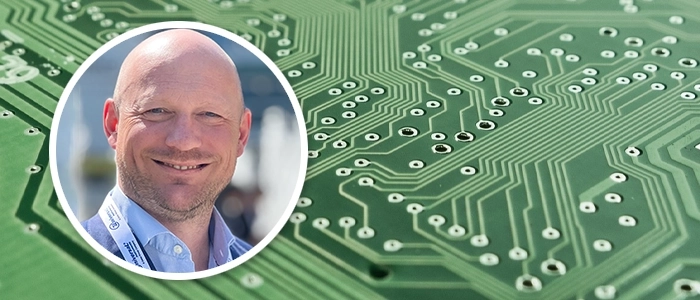
In an interview with Evertiq, Didrik Bech, board member of PCB supplier Confidee, described how the AI infrastructure boom is creating an unprecedented demand for materials, resulting in supply shortages that could reshape market conditions across several European industries.
One of China's largest PCB manufacturers specialising in AI recently informed customers that orders not placed by 10 July can no longer be delivered before 2028. Bech received the news just hours before speaking with Evertiq.
The parallels with the memory market, which Evertiq has covered extensively this year, are difficult to ignore: another critical material is becoming a strategic bottleneck as the AI industry reserves production capacity long before the rest of the market has had time to react. Bech describes the first half of 2026 as the most disruptive period he has witnessed since the dot-com crash.
A single AI rack consumes tens of thousands of PCBs
According to Bech's own estimates, a typical AI server rack contains a mix of multilayer PCBs, including 20- to 40-layer boards, alongside a number of simpler boards, adding up to as many as ten thousand PCB assemblies.
With more than 830 data centres already built worldwide and roughly another thousand planned — several of them covering around 40,000 square metres — demand for advanced PCB materials is rising rapidly.
According to Bech, the real bottleneck lies much further upstream in the supply chain, with a component that receives little attention: glass fibre fabric.
"There are really only five to seven major foundries in the world producing glass fibre fabric, and I don't believe that capacity can increase before late 2027 at the earliest," Bech said.
Four times more material – and production follows the money
Advanced PCBs require roughly four times more raw material than standard boards, according to Bech. This makes them considerably more profitable to manufacture, directing both materials and factory capacity towards AI-related production at the expense of industrial, automotive and defence applications, which typically cannot compete on margins. The effects are already becoming visible in pricing.
"If you place an order today for delivery next year, you won't get a fixed price. In the past, the factory bought the material and knew the cost. Today, the factory only learns the price once the material has arrived. This simply can't continue," Bech said.
The comparison with the dot-com bubble comes naturally. Just as few people knew which internet companies would ultimately become profitable, no one can yet say which AI companies will generate sustainable returns on today's enormous investments. Bech agrees with the comparison but points instead to those who are certain to profit regardless of who wins the race.
"It was like the gold rush in America during the 19th century. Most of the people who became rich weren't the ones who found gold — they were the ones selling picks, food, hotel rooms, you name it. Look at who's making money today: Taiwan Semiconductor," Bech said.
Bech also refers to investor Michael Burry's public scepticism regarding excessive investment in AI capacity — not AI itself. His own assessment is that some slowdown could emerge during 2027, although he stresses that this is his personal opinion based on publicly available financial reporting rather than a firm forecast.
Chips Act 2.0 barely mentions PCBs
The growing supply shortage also highlights an imbalance that Evertiq has reported on previously: the EU's semiconductor strategy remains heavily focused on a market that does not fully reflect the needs of European industry, while PCBs — without which no chip can be integrated into an electronic product — are mentioned only once in the proposed Chips Act 2.0.
"Better than nothing," Bech remarked.
Europe's own manufacturing base has shrunk dramatically. Today, only 182 PCB factories remain across Europe, compared with more than 300 in the United States, while China accounts for nearly 60% of global production. Bech also points to European import tariffs as part of the problem.
"The EU still imposes tariffs on imported laminates, even though we hardly manufacture them in Europe ourselves. The fact that these tariffs cannot simply be removed overnight makes no sense to me," Bech said.
Further upstream in the supply chain, Europe has only a single producer of copper foil, located in Luxembourg.
More defence customers, fewer ties to a single market
Confidee, which has been operating for four years, says defence customers now account for more than 40% of its business. Order intake from the defence sector increased by 119% during the first half of 2026 compared with the same period last year, while the company is adding between one and four new defence customers every month. According to Bech's own forecast, Europe's defence build-up will not accelerate significantly until the second quarter of 2027.
"That part of the challenge still lies ahead of us, not behind us," Bech said.
Today, around 40% of Confidee's business is sourced outside China, while nearly 70% of the company's qualified manufacturing partners, measured by number of factories, are located outside the country. The company's two most recent long-term manufacturing agreements have both been signed with facilities outside China. However, Bech argues that genuine diversification remains far less common than industry rhetoric suggests.
"For the past six or seven years, I've been hearing that companies want industrial production outside China. There's much more talk than reality. Even factories that have physically moved to Thailand often continue sourcing their raw materials from China," Bech said.
Ultimately, Bech believes that strengthening Europe's manufacturing base comes down to one fundamental issue: policymakers need to start talking to the industry they claim they want to rebuild.