



Omdia lifts 2026 semiconductor outlook as AI-driven memory constraints intensify
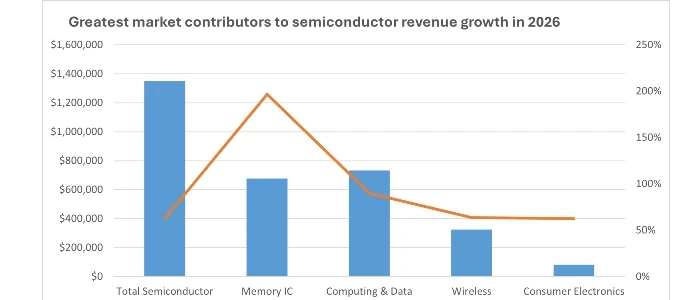
Omdia has significantly raised its 2026 semiconductor revenue forecast, now projecting growth of 62.7%, citing sustained AI-driven demand and tightening supply conditions in memory markets.
According to the market research firm, the revision reflects unprecedented growth in DRAM and NAND segments, both of which continue to be shaped by structural supply shortages. DRAM is forecast to nearly double in value compared to 2025, while NAND is expected to increase to almost four times its 2025 level.
The company attributes the imbalance in supply and demand partly to the industry’s continued focus on High Bandwidth Memory (HBM), which delivers lower volumes but significantly higher price points, reducing available capacity for conventional memory ICs.
Enterprise and data centre demand remain central to the 2026 outlook, with Omdia expecting supply relief to remain limited well into 2027.
Server cycle and hyperscaler spending drive demand
A major driver of the forecast is a broad server refresh cycle expected in 2026, aligned with elevated hyperscaler capital expenditure. Enterprises are accelerating the retirement of legacy infrastructure to support more demanding AI workloads, contributing to increased demand for higher-value system designs.
This transition is also pushing average selling prices upward, supported by ongoing component shortages and a shift toward next-generation silicon and advanced connectivity solutions.
Computing and data storage are expected to lead semiconductor revenue growth across all segments, with revenues forecast to rise 90% YoY in 2026 to exceed USD 700 billion. The increase is primarily driven by strong demand for data centre servers and other memory-intensive applications, combined with elevated memory IC pricing.
Consumer and wireless segments also benefit from pricing effects
In consumer electronics and wireless applications, semiconductor revenues are also expected to grow in 2026 despite relatively flat smartphone shipment volumes.
Omdia notes that higher memory pricing will significantly increase bill of materials (BOM) costs, driving revenue growth even in the absence of unit growth. The market is expected to see multiple flagship smartphone launches, including new foldable devices and AI-enabled models with enhanced photography capabilities.
“Supporting the progression of AI beyond simple Q&A use cases has exponentially increased demand for memory and processing ICs, fueling semiconductor industry revenues overall,” said Myson Robles-Bruce, Senior Principal Analyst at Omdia, in a press release. “However, questions remain around how quickly suppliers can scale capacity and output, and longer term, which applications will generate sufficient return on investment to justify the current levels of capital expenditure in AI.”
Omdia also points to broader risks influencing the market, including tariffs, energy costs, geopolitical tensions, and the scale of capital being directed toward AI infrastructure. The analysts note that current revenue growth is being driven primarily by higher average selling prices rather than unit shipment growth – patterns previously seen in earlier semiconductor cycles, though now at a significantly larger scale.
Industry analysis to feature at Evertiq Expo events
The structural changes in the semiconductor market will also be addressed at upcoming Evertiq Expo events in Poland and Sweden.
Semiconductor market analyst Claus Aasholm, Founder & CEO of Semiconductor Business Intelligence, will deliver a keynote titled “The Semiconductor Industry as it is, not as it is told” at both Evertiq Expo Krakow on May 7, 2026, and Evertiq Expo Lund on May 21, 2026.
Aasholm’s presentation will focus on data-driven analysis of the global semiconductor industry, including capacity expansion, capital investment patterns, supply chain shifts, labour dynamics, regional policy impacts and utilisation trends across the value chain.
Rather than following established industry narratives, the keynote aims to examine underlying structural developments shaping the sector, at a time of accelerated investment into AI infrastructure and increasingly complex supply-demand dynamics.