

From selective soldering to inspection: how THT processes are evolving
Through-hole technology (THT) has never disappeared from electronics manufacturing. But the way it is handled continues to shift — shaped less by the process itself and more by the conditions around it.
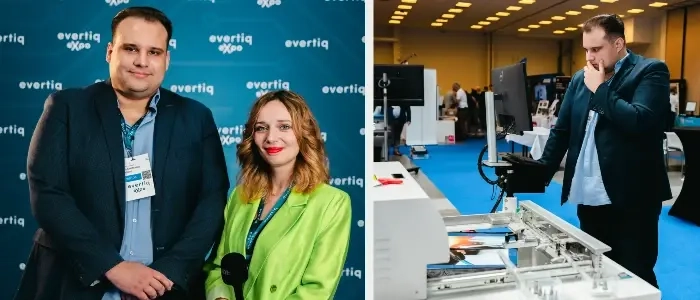
At last year’s Evertiq Expo Kraków, Karol Sowa from Sowa Electronics pointed to a tension that still defines many production environments.
“Selective soldering is essentially a technology that replaces manual soldering,” he explained in conversation with Evertiq. “The idea is to automate the process so that the machine can ensure better quality and higher efficiency than a human operator.”
Manual soldering, he noted, remains a natural starting point — but only up to a point.
“I personally enjoy hand soldering. It works well for the first few minutes. But after an hour — or several hours — the quality is no longer the same. Fatigue becomes a factor, and consistency drops.”
This is where selective soldering begins to change the equation. Not because it introduces something entirely new, but because it removes variability.
“The machine gives us repeatability,” Sowa said. “In some cases, when we have multiple pins close to each other, we can solder them in one go. It’s simply faster, and more consistent.”
Yet the choice of technology is rarely straightforward. Traditional wave soldering still has its place — particularly for certain types of assemblies — but it comes with its own limitations.
“With wave soldering, you process the entire board at once,” he explained. “That works well in some cases, but not for every design. It always depends on the product.”
What emerges is not a single dominant method, but a set of trade-offs shaped by volume, design, and available resources.
For smaller manufacturers, the constraint is often not technical, but organisational.
“You cannot just keep hiring more people indefinitely,” Sowa said. “Sometimes an order suddenly becomes three or five times larger, and you simply cannot scale your workforce that quickly. That’s when even a small, entry-level machine becomes a practical solution.”
Selective soldering itself is not new. The technology has been present on the market for decades, yet its adoption remains uneven — in part because it requires a shift in how production is structured.
“We always encourage customers to test the machine first,” he added. “It’s important to understand what configuration you actually need. There is no point in paying for options you won’t use.”
But as soldering becomes more automated, another question begins to take precedence: how to ensure that every joint is correct once the process is no longer directly controlled by a human operator.
“Each board can be tracked, and the process is defined step by step,” Sowa said. “At every stage, you can monitor what is happening and ensure that each solder joint is produced in exactly the same way.”
This is where the focus is now shifting — from soldering itself to inspection.
Karol Sowa will return to Evertiq Expo Kraków (May 7). This year he will perform with a presentation on automated optical inspection (AOI) in THT assembly. The talk will explore inspection both before and after soldering, covering 2D and 3D technologies as well as simultaneous inspection of both sides of the PCB.
As THT processes become increasingly automated, inspection is no longer a secondary step. It becomes part of the process itself — a way to maintain control in systems where consistency is no longer guaranteed by human hands, but by how well the system is designed to observe itself.