



From rigidity to agility: modular robotics gains ground in EMS manufacturing
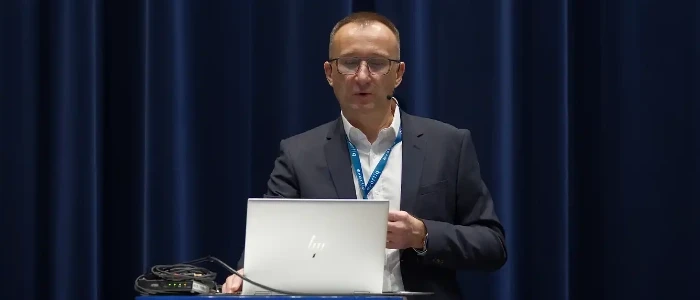
Electronics manufacturers operating in high-mix, low-volume (HMLV) environments need more flexible automation to remain competitive, according to Piotr Owczarek of Fideltronik, Fitech and AIRob. Speaking at the Evertiq Expo Tampere 2026, he outlined how modular robotics and AI-driven systems can address the limitations of traditional automation.
Owczarek explained that the company’s approach to robotics was born out of necessity. As labour costs increased, automation became essential to sustain production in higher-cost countries. However, conventional automation proved difficult to implement efficiently in HMLV environments.
“When we started, it appeared that we were replacing one or two operators with one robot and two engineers,” he said, describing early efforts as cost-inefficient.
Instead, the company shifted its focus towards flexibility, developing modular robotic systems capable of handling multiple products within a single process. Rather than building automation around a fixed product, the approach centres on adaptable workstations that can be reconfigured depending on demand.
The concept also includes making robots more human-like in their interaction with tasks, with sensory capabilities such as vision and touch to improve understanding of what they are handling and doing. The company sees this as a path toward greater automation, aiming to build systems capable of handling different processes through simple changeovers.
“We are not focused on one product, one process — but one process, different products,” Owczarek said.
A key feature of the concept is mobility. Production cells can be moved between lines or customers depending on production load or seasonal demand, allowing manufacturers to better utilise equipment across fluctuating volumes.
The systems are built using modular blocks, enabling process engineers — rather than robotics specialists — to configure and operate them. According to Owczarek, this reduces dependency on highly specialised skills on the shop floor.
“All our machines are working like typical shop floor equipment — only operator and technical skills are needed,” he said.
Artificial intelligence plays a central role in enabling this flexibility. Instead of relying on fixed positioning, the robots use vision systems and AI algorithms to identify, pick and place components in varying conditions.
One example is the ability to handle randomly positioned components. Rather than requiring precise mechanical alignment, the system determines the optimal way to pick each component based on its orientation.
“Artificial intelligence is deciding what's the easiest way to pick the component,” Owczarek explained.
More advanced capabilities include collision detection, 3D positioning, and adaptive placement of components such as through-hole technology (THT) parts, where variations in shape require continuous adjustment — similar to how a human operator would handle them.
Beyond assembly, AI is also used for quality control. Owczarek presented a system capable of detecting component presence, orientation, text (OCR), and visual defects, with minimal setup time.
“If you have a solution already on the shop floor, it takes five to 15 minutes to add a new product,” he said, adding that most applications in electronics manufacturing require little to no additional training of the system.
According to Owczarek, the technology has already been tested extensively in real production environments, with millions of images processed and hundreds of installations deployed.
Unlike many automation solutions developed in laboratory settings, these systems are validated directly on the shop floor. “This is not a theory — it’s a real working solution in production,” he said.
Despite the advances in automation, Owczarek stressed that full automation is neither realistic nor desirable. Instead, he advocates a balanced approach.
“You can automate maybe 70 to 80% of the production, but there are still operations better handled by humans,” he said.
The modular approach is particularly suited to production scenarios with frequent changeovers and smaller volumes — ranging from hundreds to tens of thousands of units annually — rather than mass production.
As manufacturers continue to face rising costs and increasing complexity, Owczarek’s conclusion was clear: flexible, modular automation — supported by AI — will be essential to maintaining efficient production in high-cost regions.
The discussion around modular robotics is set to continue later this spring, as Owczarek prepares to return to Evertiq Expo Krakow 2026 on May 7. There, he will once again take to the stage to explore how manufacturers can move away from rigid automation models and instead build agility into production through modular robotics tailored for high-mix, low-volume environments.