


Infineon and ZuriQ expand partnership on trapped-ion quantum chips
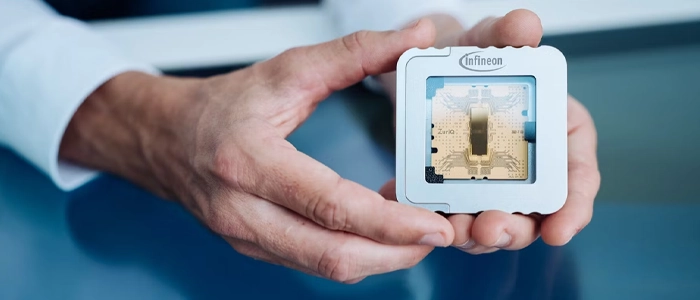
Infineon and Swiss quantum computing start-up ZuriQ are expanding their collaboration to scale ZuriQ's trapped-ion architecture towards larger qubit counts. The partnership combines ZuriQ's chip design with Infineon's semiconductor manufacturing, advanced packaging and integrated photonics.
In earlier joint work, the companies trapped a 3×3 array of nine individually controlled ions, which they describe as the largest two-dimensional array of its kind to date, according to a press release from Infineon. The next step is to scale the technology to significantly more qubits.
"Through our collaboration with Infineon, which possesses a deep understanding of process development and semiconductor technologies, we are turning ZuriQ's technological progress into scalable, manufacturable quantum hardware," says Pavel Hrmo, co-founder and CEO of ZuriQ.
Unlike conventional trapped-ion quantum computers, which hold ions in one-dimensional chains, ZuriQ's design is natively two-dimensional. It uses a so-called Penning micro-trap, where electric and magnetic fields move the ions directly across the chip. According to the companies, this avoids complex junction structures and makes it easier to build larger qubit arrays.
"With our expertise in semiconductor manufacturing, integration and advanced packaging, we are enabling the next generation of trapped-ion quantum processing units," says Clemens Rössler, Senior Director and Head of Quantum Processing Units at Infineon.
ZuriQ was founded in 2024 as a spin-off from ETH Zurich. The companies do not say how many qubits they are targeting, on what timeline, or how the expanded collaboration is structured or financed.