


TetraMem announces 22nm RRAM analog IMC SoC milestone
The US company’s MLX200 platform integrates multi-level RRAM arrays with mixed-signal compute engines to enable high-throughput vector-matrix operations within memory, while maintaining compatibility with advanced CMOS processes.
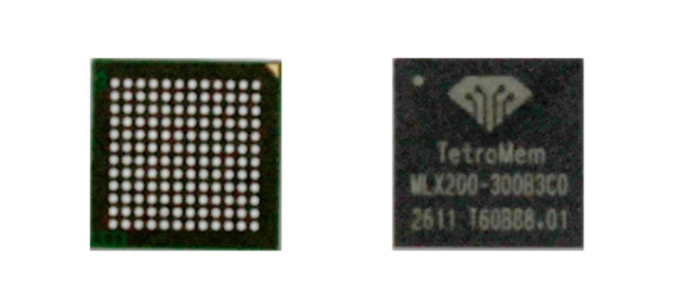
TetraMem, a Silicon Valley–based semiconductor company developing analog in-memory computing (IMC) solutions, has announced the successful tape-out, manufacturing and initial silicon validation of its MLX200 platform, a 22nm multi-level RRAM-based analog IMC system-on-chip (SoC).
The achievement marks a significant step toward the commercialization of analog computing architectures based on emerging non-volatile memory technologies, addressing the growing challenges of data movement, power consumption, and thermal constraints in modern AI systems, the company said.
TetraMem’s MLX200 platform integrates multi-level RRAM arrays with mixed-signal compute engines to enable high-throughput vector-matrix operations within memory, while maintaining compatibility with advanced CMOS processes.
The multi-level RRAM technology demonstrated at the TSMC 22nm process provides key attributes required for practical deployment, including CMOS compatibility with minimal additional process complexity, low-voltage and low-current operation, strong retention and endurance characteristics, and high multi-level capability that supports improved memory and compute density, according to a media release.
The MLX200 and MLX201 platforms are designed to support power- and latency-sensitive edge AI applications, including voice and audio processing, wearable devices, IoT systems, and always-on sensing. Evaluated sampling is expected to begin in the second half of 2026, and multi-level RRAM memory IP is available for evaluation and potential licensing.
“This milestone reflects years of close collaboration with our foundry partner TSMC and demonstrates the feasibility of bringing multi-level RRAM and analog in-memory computing from computing architecture breakthrough into advanced-node commercial silicon,” Dr. Glenn Ge, Co-founder and CEO of TetraMem, said. “We believe this approach provides a practical path to improving energy efficiency and scalability for next-generation AI systems.”