




How chips competence centres could change semiconductor hiring in Europe
Europe is investing heavily in semiconductors. New fabs are being planned, public funding is flowing, Chips Act 2.0 is on its way and long-term initiatives are taking shape. But there’s a more basic question that doesn’t seem to get asked enough: Even if all of this gets built, who is going to run it?
Author: Claude Loeffen, CEO at The Silicon Search
In my work, I spend a lot of time speaking with semiconductor leaders across Europe specifically about talent and hiring, and it gives a different perspective on how these plans translate into reality.
The industry is facing a shortage of experienced engineers, not enough people with a few years of hands-on experience to support growing teams, and a gap between what graduates learn and what semiconductor companies actually need.
So the question becomes: where are the practical solutions to this? And are we overlooking initiatives that could already help address it?
What’s interesting is that part of the solution is already being built, yet it hardly comes up in this
context:
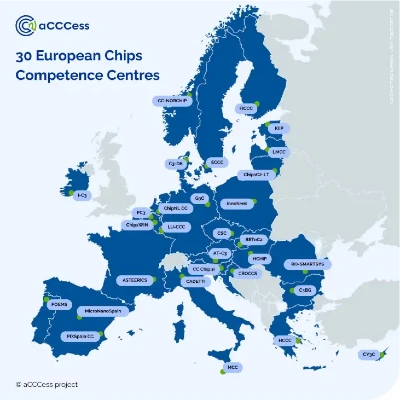
Chips Competence Centres, and the role they could play in shaping how talent is developed and accessed across the industry.
Over the last year, Europe has started rolling out something called Chips Competence Centres.
In simple terms, these are national hubs set up under the European Chips Act. There are 27 of them across Europe, connected through a coordination structure called aCCCess. Together, they form a European network that links companies to:
● The European Design Platform
● EU-funded pilot lines
● Training and education programmes
● Technical expertise and infrastructure
On paper, it sounds ambitious. So I wanted to understand what this really means in practice.
Not from a policy point of view, but from a hiring point of view.
Because if Europe is building shared design infrastructure, training networks and cross-border collaboration platforms, that will affect how semiconductor companies build teams. So I started speaking with people involved in a few of these centres.
Here’s what I learned.
1. This is clearly designed to support startups and SMEs first
The primary target group is SMEs and startups.
That is important.
Why? Because many smaller semiconductor companies usually struggle with:
● Access to advanced design tools
● Access to prototyping
● Access to fabrication pathways
● Access to experienced technical advisors
The Competence Centres are meant to act as entry points to all of that, including access to pilot lines and the European Design Platform.
From a hiring perspective, this changes perception I believe.
When a startup can show it is connected to national and European infrastructure, applicants will probably feel less
risk. It feels less like a standalone bet and more like part of a structured ecosystem.
That should make hiring easier in my experience.
2. The Design Platform could influence how teams are built
The European Design Platform linked to this initiative aims to provide:
● Access to EDA tools
● IP libraries
● Prototyping
● Fabrication pathways
● Packaging and testing
● Training sessions
If infrastructure becomes easier to access externally, early-stage teams may not need to hire as many infrastructure-heavy profiles upfront.
Instead, they may focus more on:
● Architecture
● System design
● Core IP
● Product differentiation
That could potentially change what “first 10 hires” look like in a new semiconductor company.
3. Training is formally built into the structure
It is important to understand that this is not just about access to tools. The initiative explicitly includes links to higher education and vocational training networks and the people that I spoke with have stressed that out clearly.
Some centres are already running or planning:
● Technical workshops
● Skills development programmes
● Cross-border collaboration events
In conversations with hiring managers, the topic of specific skill gaps comes up quite often.
They tell me graduates don’t have enough hands-on experience with real design flows. They lack exposure to advanced nodes. They haven’t worked with industry-grade verification environments. They understand theory, but not tape-out pressure.
But what I also find is that, at the same time, very few of those same hiring managers are actively connected to the institutions shaping those engineers.
To me that is the disconnect.
From what I have seen the Competence Centres are actually designed to sit exactly in
that middle layer between universities, research institutes, pilot lines and industry.
They are supposed to:
● Align training programmes with real industrial needs
● Provide access to design tools that universities alone might not afford
● Organise joint workshops with companies
● Create structured collaboration between SMEs and academia
If that works, companies don’t just “receive” graduates. They influence what those graduates are actually trained on. And that changes the equation completely.
Instead of saying, “The market doesn’t produce the profiles we need,” companies could help shape the pipeline two or three years earlier.
But that only happens if hiring managers move from passive observers to active participants.
Otherwise, the centres become another initiative that exists on paper while companies continue to hire reactively.
4. This is a coordinated European network
The 27 centres are not isolated projects. They are connected through a four-year coordination action that aims to:
● Harmonise services
● Share catalogues
● Enable matchmaking across borders
● Connect companies to pilot lines and the Design Platform
In theory, a company in one country can access expertise or infrastructure in another through this network.
If that works in practice, it reduces one of the traditional barriers to cross-border collaboration: dependency on local infrastructure. A startup in Portugal, for example, doesn’t necessarily need every capability in-house if it can access packaging expertise in another member state or tap into a pilot line elsewhere in Europe.
From a hiring perspective, that will change how we think about team structure.
Instead of hiring only within commuting distance of your lab or design centre, you can think more flexibly:
● Architecture in one country
● Verification in another
● Access to prototyping through a partner centre
It doesn’t eliminate the need for strong local teams. But it makes distributed European team models more viable, especially for specialised skills that are concentrated in specific regions. Over time, that could reduce the pressure to relocate every critical hire.
And instead allow companies to build around capability clusters across Europe rather than around single physical locations.
5. Maturity levels vary
Some centres are clearly active and visible.
Spain has two centres with different technical focuses, including photonics. Nordic and Baltic centres are coordinating across borders. Others are still building governance and services.
That means hiring impact will not be equal across Europe.
Some ecosystems will benefit earlier.
6. This could actually redefine regional talent ecosystems
From what I can see, each centre reflects national or regional strengths.
That means the network is not trying to make every country good at everything. Instead, it leans into what already exists.
In practice, that could mean:
● Photonics concentrated in one region
● Advanced packaging expertise in another
● Specific IC design capabilities building up elsewhere
If companies start aligning with these nodes, we may see clearer technical identities
forming across Europe.
From a hiring perspective, I am sure that that has real implications.
From my experience, specialised clusters tend to attract:
● Experienced engineers who want to stay close to their domain
● Spin-offs and startups building around local expertise
● Universities adapting programmes to match regional industry
Take the Eindhoven brainport region in the Netherlands as an example. The region already has strong semiconductor roots with companies like ASML and NXP, plus a technical university closely linked to industry.
What happens in clusters like this?
Experienced engineers tend to stay because their expertise is directly relevant locally. Spin-offs and startups emerge from larger players. Universities adapt programmes to match industry needs.
Over time, I believe that we will get a concentrated talent pool in a specific domain. That’s the kind of dynamic Competence Centres could strengthen if they truly build around regional strengths.
Yes, it increases competition locally for certain profiles. But it also creates deeper talent pools over time. And deeper pools usually lead to stronger peer networks, more knowledge exchange, and a more mature hiring market within that niche.
For companies building in Europe, understanding where those clusters are forming may become just as important as understanding salary benchmarks.
My own takeaway
To be honest, I don’t see Competence Centres as a quick fix for anything. But I do see them as infrastructure that hiring managers should at least understand. Most companies I speak with have not actively engaged with their national centre.
In a way, that surprises me.
Because if you are building semiconductor teams in Europe right now, this is one of the few structured, funded frameworks connecting: Infrastructure Training SMEs Cross-border collaboration.
And it is very likely that this will influence hiring decisions over the next few years.
Claude Loeffen is the CEO of The Silicon Search. He works with semiconductor companies across Europe on hiring and building teams, with a focus on long-term talent challenges in the industry. He is actively involved in the semiconductor ecosystem and writes a weekly newsletter focused on hiring, careers, and growth in the sector.