



"Artificial intelligence will support us, not replace us"
High-mix, low-volume production has long been one of the most complex operational environments in the EMS industry. Short production runs, high product variability, frequent changeovers and constant time pressure mean that factories operate in a state of near-constant adaptation. At the same time, customer expectations for quality and flexibility continue to rise, while the availability of skilled labour remains limited. In such conditions, manufacturing ceases to be a collection of independent processes — it becomes a system in which every change carries wider operational consequences.
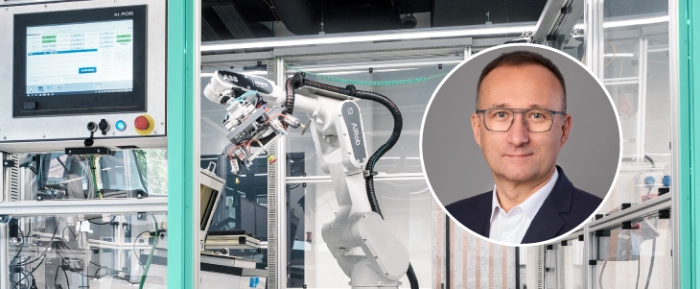
It is precisely from this perspective that Piotr Owczarek views the role of artificial intelligence in the EMS environment. Owczarek is CEO of AiRob, part of the Fideltronik Group — one of Central Europe’s largest EMS providers. As he told Evertiq in an interview, the key issue is not the implementation of technology itself, but how it fits into the overall organisation of production.
Starting from the production floor, not the technology
Piotr Owczarek’s professional career has been directly linked to electronics manufacturing from the very beginning. His experience includes many years in roles responsible for production continuity, quality and on-time delivery — areas where every technological decision has very concrete operational consequences.
“I started working in a manufacturing company almost 25 years ago, at a time when the competitive advantage of Polish factories was based largely on low labour costs. Over the years, everything has changed. If we want to maintain manufacturing in Poland and Europe today, we have no choice — we must automate just as other countries do, because only then can we compete with Asian manufacturing. My interest in automation and artificial intelligence did not come from a fascination with technology, but from the need to solve very specific problems that appear every day on the production floor.”
This perspective — rooted in the realities of the factory floor rather than in technological promises — largely defines how Piotr Owczarek speaks about AI in the context of EMS.
EMS as a system
In a high-mix, low-volume environment, production functions as a tightly interconnected system. Product variability affects planning, planning affects operator workload, and this in turn influences quality and process stability. In such a setup, even minor disruptions can escalate quickly.
According to our interviewee, one of the most common mistakes is treating automation as an isolated technological project. In reality, every intervention in the production process affects the entire system — from people and work organisation to responsibility for decision-making.
“Automation in EMS does not happen in a vacuum. It is not a case of implementing one workstation while the rest of production continues unchanged. Every such solution influences how operators work, how managers assume responsibility, and how stable the supply chain remains. If someone thinks about AI purely as a technology rather than as part of the production system, disappointment is very likely.”
In this context, artificial intelligence plays a stabilising role. It helps reduce variability where it is most costly, but it does not eliminate it entirely.
Where AI is already delivering real value
Although in public debate AI is often framed as a promise of the future, many solutions are already being used on production floors. Within the Fideltronik Group, systems based on artificial intelligence have been developed for several years, and their implementation was preceded by a long period of testing and iteration.
One of the most mature areas for AI deployment remains quality control.
“If a person spends eight hours looking at the same PCBs, each with hundreds of components, sooner or later their attention fades. Artificial intelligence does not have this problem. It is consistent, patient and repeatable. And this is precisely where it outperforms humans,” explains Piotr Owczarek.
AI is also being used in processes that require precision and repeatability, such as THT component assembly, soldering, silicone dispensing, and PCB handling during testing and packaging. In these cases, algorithms make operational decisions without the need for traditional programming, adapting to changing conditions and product variability.
Modularity as a way to manage variability
Growing product mix and increasingly shorter production runs mean that traditional, rigid production lines are failing more and more often. Instead of supporting efficiency, they can become a constraint for the entire factory, reducing flexibility and increasing costs. An effective response to these challenges is modularity — not only technological, but organisational as well.
“Long, fixed production lines are no longer coping with this reality. What we need are modules that can be quickly moved, reconfigured and adapted to current production needs. Otherwise every product change means significant cost and downtime.”
AI-controlled modular robotic stations make it possible to respond to change without redesigning automation from scratch for each product. In a high-mix, low-volume environment, however, their importance lies not only in technical flexibility. Equally important is the fact that they fit into a broader way of thinking about manufacturing as a system that must maintain balance between technology, people and operational risk.
Not everything needs to be automated
From a systemic perspective, the limitations of a full-automation approach become particularly clear. According to Piotr Owczarek, the pursuit of automating one hundred percent of processes often leads not to simplification, but to increased complexity and greater system vulnerability to errors.
“There are processes that are much easier and cheaper to perform with human involvement. If we try to automate them by force, instead of stability we get a complex system that is difficult to maintain and expensive to operate. In practice, the best results usually come from automating 70–90% of processes, while the remaining tasks are handled by operators.”
Such an approach not only improves return on investment but also preserves the flexibility required in an environment of variable production runs and constantly evolving orders. Automation thus ceases to be an end in itself and instead becomes a stabilising element within the production system.
Risk as the main barrier to transformation
Although the technology is maturing, the real constraint on EMS transformation remains organisational culture and the approach to risk. From the perspective of those responsible for delivery continuity, every new technology represents a potential disruption — and in a production environment such disruptions have very tangible consequences.
“As a factory director, I had to deliver products today and tomorrow. Investing in a new, unproven technology never provides one hundred percent certainty. And this fear of destabilisation very often blocks decisions about automation.”
In this sense, the problem is not the lack of available solutions, but the willingness of organisations to accept controlled risk and to change the way they think about manufacturing.
AI as support, not a replacement
This is where the role of artificial intelligence becomes most clearly defined — not as a substitute for humans, but as a tool that supports decision-making and stabilises processes. As Piotr Owczarek emphasises, AI algorithms operate probabilistically, which requires awareness of their limitations and a clear distribution of responsibility.
“Artificial intelligence will support us, not replace us. And only when we start looking at it this way can we build a healthy ecosystem — one in which technology, people and organisation complement one another.”
In areas that require long periods of concentration, repeatability and precision, AI often performs better than humans. However, where safety, interpretation of complex situations or decisions with wide-ranging consequences are involved, responsibility must remain with people.
From fascination to maturity
According to our interviewee, the current enthusiasm surrounding artificial intelligence will gradually give way to a more mature approach. After the initial wave of excitement about a new technology comes the moment when we begin to understand its real capabilities and limitations.
“Over time, we will start to treat artificial intelligence as an ordinary tool — helpful and supportive, but not infallible. And that will be the best moment to truly unlock its potential,” explains Piotr Owczarek.
In this sense, the future of AI in EMS manufacturing does not lie in replacing people, but in building a coherent and resilient system in which technology supports humans rather than attempting to eliminate them.
Piotr Owczarek will speak more about the practical use of artificial intelligence and modular robotics in high-mix, low-volume manufacturing during his presentations at Evertiq Expo in Tampere (March 26) and Evertiq Expo in Kraków (May 7), titled “Flexibility in practice: Artificial intelligence and modular robotics in high-mix, low-volume production.”