



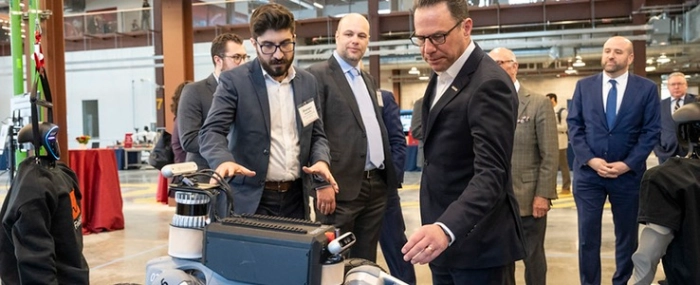
Carnegie Mellon opens robotics innovation hub in Pittsburgh
The Robotics Innovation Center’s features include a 50,000-square-foot indoor robot testing floor; flexible high-bay research spaces; specialized labs supporting interdisciplinary collaboration; and a 1.5-acre outdoor robotics testing area.
Carnegie Mellon University (CMU) has opened the Robotics Innovation Center (RIC), a 150,000-square-foot facility designed to accelerate breakthroughs in robotics, artificial intelligence and advanced automation.
“Today is about more than celebrating the opening of a building,” said Farnam Jahanian, CMU President. “We’re also celebrating the strength of the many ongoing partnerships: partnerships with all levels of government, and with civic, research and industry leaders — across our region, our nation — and in fact, the world.”
The RIC’s features include a 50,000-square-foot indoor robot testing floor; flexible high-bay research spaces; specialized labs supporting interdisciplinary collaboration; and a 1.5-acre outdoor robotics testing area, including a dedicated drone flight cage, the university said in an online post.
These spaces will enable researchers and students to design, test and deploy robotic systems that operate on land, in the air and in water — technologies that touch industries ranging from health care and manufacturing to agriculture, infrastructure and national security, Carnegie Mellon said.
The RIC has already welcomed its first corporate tenant, the robotics unicorn FieldAI.
“At FieldAI, we believe that if you want to build the future of robotics you should do it alongside the institution that defined the field in the first place,” said Shayegan Omidshafiei, president and chief scientific officer of FieldAI.
Pennsylvania Governor Josh Shapiro announced the state will invest in the university’s plan to develop a new 25,000‑square‑foot physical AI accelerator inside the RIC with a USD 1.5 million Redevelopment Assistance Capital Program grant to support its construction.