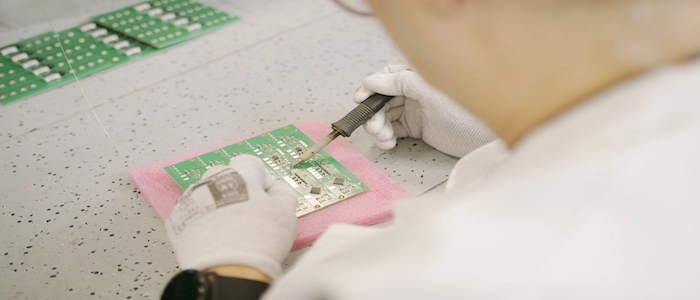
What competencies are really important when choosing an EMS partner?
By outsourcing production and assembly to specialized EMS suppliers, companies can focus on developing technology, software or sales, while avoiding the need to maintain their own production infrastructure. However, the growing complexity of projects means that selecting the right EMS partner is now essential for ensuring product quality, reliability and scalability. Technological expertise, experience, and the ability to guide customers through the entire process, from design to the final product, are therefore essential.
“At Nordes, we prioritize quality and flexibility at every stage of our collaboration. A good EMS supplier should perform assembly and also discuss, and propose appropriate technology to customers, analyze designs and propose the optimal selection of SMD components, as well as taking responsibility for physically assembling PCBs, enclosures and the entire logistics process”, emphasizes Marek Lendor, Production Director at Nordes.
The importance of SMT and THT technologies in modern electronics manufacturing
These technologies form the basis of modern electronics manufacturing, and selecting them correctly is crucial for ensuring the functionality and reliability of devices. SMT involves mounting components directly onto the surface of a PCB, and modern pick-and-place lines enable high automation, miniaturization and precise assembly. Although THT is an older technology, it is still indispensable for designs that require exceptional mechanical strength and resistance to harsh operating conditions. Soldered connections through PCB holes are ideal for applications involving high temperatures, vibrations or high current loads.
“Many modern devices combine both technologies, allowing for an optimal balance of miniaturization and durability. The role of an experienced EMS partner is to select the right assembly method, analyze the PCB design, and optimize the process in terms of quality, functionality, and cost, for both series and prototype production”, adds Marek Lendor.
Production capabilities: from prototypes to mass production
A modern EMS provider must be able to handle orders of all sizes, from single prototypes to pilot series and mass production of electronic devices. This requires flexible infrastructure and the ability to reconfigure production lines quickly, as well as the capacity to transition smoothly between the various stages of product development. This ensures that customers do not have to change partners during the project.
Design support, including design for manufacturability (DFM) verification, technological optimization and design consulting, is also becoming standard practice. EMS companies are increasingly offering PCB design and modification services, reducing the need for intermediaries and ensuring consistency throughout the process. An integrated approach accelerates the implementation of changes, improves production quality and increases repeatability. A partner involved in the technical documentation stage has a better understanding of the device's functional requirements, resulting in shorter implementation times, lower risk and more predictable costs.
“An EMS company demonstrates its greatest strength when it can provide a complete value chain — from concept and design to the production and testing of the finished device. This approach speeds up project implementation, ensures consistency between documentation and the manufacturing process, and increases the predictability of costs and deadlines”, emphasizes Bartłomiej Kasiewicz, R&D Manager at Nordes.

How can the quality, experience and efficiency of an EMS provider be assessed?
Selecting the right EMS partner requires an analysis of several key areas. The most important of these is experience, particularly in serving specific industries and implementing projects of varying degrees of complexity. It is also worth checking whether the company works with demanding components, manufactures in accordance with industry standards, and has expertise in specific sectors such as medicine, defence and aerospace.
Another factor is the quality of the production infrastructure. Modern machinery and SMT lines equipped with AOI and X-ray systems demonstrate the ability to maintain high repeatability and stability of production, as do advanced testing tools and solutions for automatic process control. The level of digitization is also important, for example the ERP system and integration with customer documentation, as well as full verification of a given batch, known as traceability. These factors translate into the predictability and operational security of the project.
Supplier reliability is evidenced by certificates such as ISO 9001, ISO 14001, ISO 45001 and IPC-A-610, which confirm compliance with international quality procedures.
“ISO quality management system certificates are crucial in the electronics manufacturing industry, because they guarantee process stability, safety, environmental compliance and proper working conditions. Nordes also holds an ISO 13485 certificate, which is a quality certificate for medical devices. This is essential for PCB production for medical devices because it confirms compliance with stringent safety and effectiveness standards”, emphasizes Sylwia Piątkowska, QMS Representative and Administration Department Manager at Nordes.
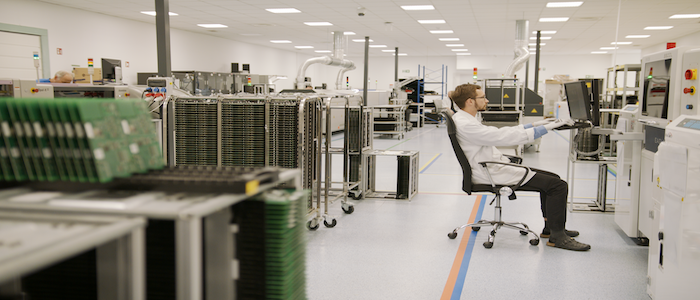
Key trends in contract electronics manufacturing services
The electronics industry is growing faster than ever before. The increasing complexity of designs, coupled with the pressure to shorten product implementation cycles, is forcing a completely new approach to assembly technology. The future of EMS services will be based on automation, process digitalization and intelligent production data analysis due to component miniaturization, higher packing density, the need for high production flexibility and ever-increasing quality requirements.
In the modern market, both industrial and consumer sectors expect devices that are technologically advanced, reliable, energy-efficient, and compliant with stringent environmental standards. Consequently, the remit of EMS companies has expanded beyond physical assembly. They are increasingly responsible for full design, consulting and logistics support, including documentation verification, cost optimization, functional testing and comprehensive product management. This integrated model of cooperation, combining design, assembly and related services, is becoming a key factor in competitiveness within the rapidly growing electronics market.
In future, companies that can fully integrate design, assembly, testing and logistics will not only be partners, but also a strategic pillar of success for manufacturers in every industry. Electronics assembly is now an integral part of an innovative ecosystem where every detail matters.