

Heterogeneous core technology for multifunctional embedded client systems
The current procurement challenges cause the manufacturers of electronic components to use their scarce resources for high-margin new components. If an application uses older components, the entire value stream right through to the finished OEM product faces immense procurement problems. If the most expensive components in an embedded system – i.e., the processor and main memory – are affected, this challenge can be mastered much more easily if the system is based on Computer-on-Modules. Not to mention that one-off development costs (non-recurring engineering, or NRE costs) can also be amortized more sustainably with such modular systems.
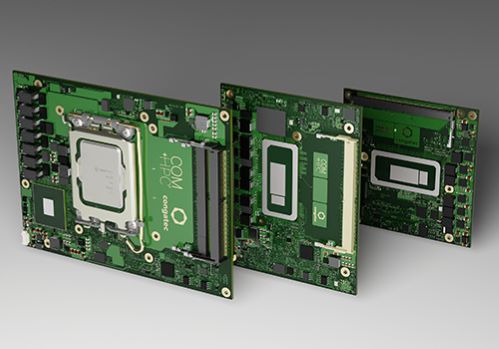
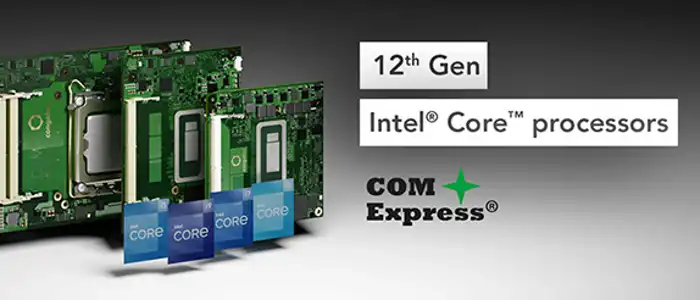
congatec offers 12th generation Intel Core processors on COM-HPC Size A and C as well as COM Express Type 6.
High-end workstations and desktop clients
The sustainability advantages and greater procurement security of Computer-on-Modules are not only interesting for dedicated systems with very individual sets of interfaces. Standard solutions such as industrial high-end workstations and desktop clients – as found in control centers, medical imaging technology or at airports, where thousands of computers power everything from flight display boards to baggage check-in and boarding systems – can also benefit from deploying Micro-ATX-compatible carrier boards with COM-HPC slots, for example. OEMs leveraging such modular system designs can eliminate the traditional revision requirements for standard or semi-industrial ATX-compatible motherboards, which are usually only available for three to five years.
At the same time, use of modules also offers extended scalability compared to classic motherboard designs, which must be configured for dedicated processor sockets or BGA assembly. Effectively, the entire range of 12th generation Intel Core processor-based Computer-on-Modules can be used. Their hybrid architecture is highly sustainable because the performance can be better balanced, which reduces power consumption for a given TDP. This is an increasingly important aspect in times when overall energy consumption must be throttled by 15%, although admittedly, a reduction in the energy consumption of embedded computers in the industrial sector is only a small drop in the bucket. Conceptually, the hybrid architecture enables machine and plant manufacturers to benefit from other, significantly greater cost savings: namely, through workload consolidation.
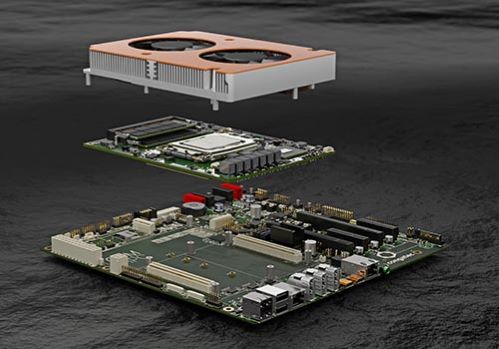
The Micro-ATX compatible carrier for COM-HPC Client Size A, B or C modules enables the development of more sustainable high-end workstations and desktop clients.
Workload consolidation for machines and systems
The mere fact that embedded client processors can now orchestrate up to 16 cores for the first time provides sufficient flexibility for many embedded and edge computing systems to consolidate heterogeneous workloads in a single system. This saves immense costs as well as power during operation. Not that such consolidation was impossible before. But the option to consistently implement such a solution step by step over a longer period and then being able to adapt the platform as needed with each new function by adding new cores has never existed as distinctly and precisely within a processor family as it does now.
The fastest COM Express Type 6 and COM-HPC Client Size A modules to date with 11th generation Intel Core and Xeon processors only offered up to 8 cores. If you wanted to consolidate real-time control, HMI and numerous gateway functions along with image pre-processing and artificial intelligence on a single real-time capable client platform, this was only attractive for less complex distributed systems. And even then, you wasted more powerful cores for less power-hungry real-time tasks. However, the technology leap towards workload consolidation is even more interesting for vendors who have a lot of distributed heterogeneous intelligence, because here the savings potential is even greater. This, however, requires many cores and, importantly, not just large but also smaller ones. Such heterogeneous architectures are now available for x86.
Up to 16 cores and 24 threads
The up to 16 cores and 24 threads make it much easier to consolidate several homogeneous robot controllers for example, which customers may need for a certain production step or specific material handling tasks, on a single hardware and then centrally orchestrate the interaction between these robots. In that case, the controllers communicate exclusively via virtual Ethernet between the individual cores, which all get their own real-time capable virtual machine. Sensors and actuators are connected via Ethernet, for example. Everything is also synchronized in real time using TCC (Time Coordinated Computing) and TSN (Time Sensitive Network) support. Increasingly, connectivity to higher-level edge servers is being established using wireless 5G campus networks, and thanks to the large number of cores, multiple options for network function virtualization are available here, which are best implemented with Type 1 hypervisors (bare metal hypervisor, fully real-time capable in privileged mode) to avoid real-time losses. If the cages around the manufacturing cells are removed to realize cobot applications, extremely performance-hungry sensor technology is deployed to add situational awareness. All of this requires more and more computing power, for which the new Intel Core processor technology now offers significantly more scope.
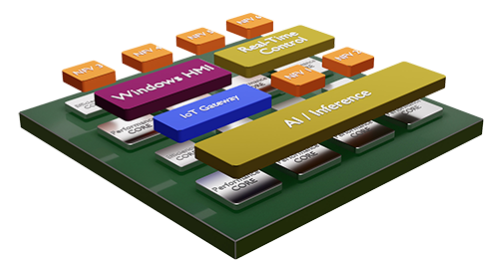
Providing support for Real-Time Systems’ hypervisor technology as well as operating system support for Real-Time Linux and Wind River VxWorks, congatec offers a truly well-rounded ecosystem package
For instance, the graphics of the LGA processor-based modules, which are optimized for highest embedded client performance, deliver up to 94% more performance compared to previously available Intel Core processor-based modules. Their inference performance for image classification has also nearly tripled, with up to 181% higher throughput. In addition, the modules provide hugely more bandwidth for connecting discrete graphics processing units (GPUs) for highest graphics and GPGPU-based AI performance.
Processor-integrated artificial intelligence
Beside fast DDR5 memory, high bandwidth and up to PCIe Gen 5 performance, the new flagship modules in COM-HPC Client format also impress with dedicated AI engines that support Windows ML, the Intel distribution of the OpenVINO toolkit and Chrome Cross ML. The various AI workloads can be seamlessly delegated to the P-cores, E-cores and the GPU execution units to handle even the most intensive edge AI workloads. The integrated Intel Deep Learning Boost technology leverages the various cores via Vector Neural Network Instructions (VNNI). The integrated graphics also support AI-accelerated DP4a GPU instructions, which can even be scaled to dedicated GPUs. In addition, Intel Gaussian & Neural Accelerator 3.0 (Intel GNA 3.0) – this is Intel’s integrated AI accelerator with ultra-low power consumption – enables dynamic noise reduction and speech recognition. It can be voice activated even when the processor is in power-saving mode.
For further information, please visit https://www.congatec.com/en/technologies/intel-alder-lake-modules/
About congatec
congatec is a rapidly growing technology company focusing on embedded and edge computing products and services. The high-performance computer modules are used in a wide range of applications and devices in industrial automation, medical technology, transportation, telecommunications and many other verticals. Backed by controlling shareholder DBAG Fund VIII, a German midmarket fund focusing on growing industrial businesses, congatec has the financing and M&A experience to take advantage of these expanding market opportunities. congatec is the global market leader in the computer-on-modules segment with an excellent customer base from start-ups to international blue chip companies. More information is available on our website at www.congatec.com or via LinkedIn, Twitter and YouTube.
Reader enquiries:
congatec
Phone: +49-991-2700-0
info@congatec.com www.congatec.com