



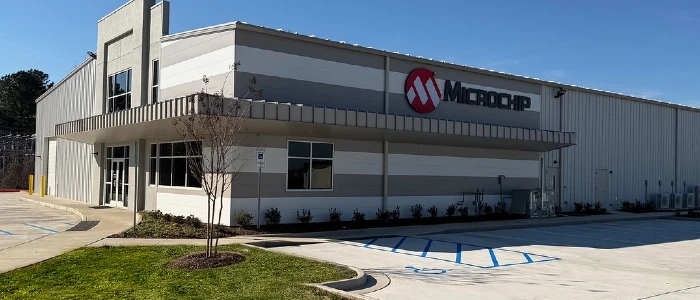
Microchip expands hydrogen maser production with new Alabama facility
US semiconductor company Microchip Technology has opened a new manufacturing facility in Tuscaloosa, Alabama, to increase production capacity for its hydrogen masers and reduce lead times.
The expansion comes amid growing demand for high-precision timing systems, as hydrogen masers play a key role in maintaining Coordinated Universal Time (UTC) and supporting critical infrastructure such as power grids, telecommunications networks and satellite communications.
The new site will focus on the production of Microchip’s MHM-2020 Active Hydrogen Maser, which is designed for applications requiring high frequency stability and low phase noise, including scientific research, radio astronomy, deep space tracking and GNSS/GPS ground stations.
In addition to hydrogen masers, the facility will support the manufacturing of other timing and synchronisation products, including the Auxiliary Output Generator (AOG-110) and the 1000C-OCXO crystal oscillator.
Microchip has an established presence in the region through earlier acquisitions and has operated in Tuscaloosa County for several decades. The new facility spans approximately 15,000 square feet and includes temperature-controlled testing areas and research and development capabilities.
The company has also strengthened its collaboration with the University of Alabama, including joint work on timing and frequency technologies, as well as training and student engagement.
“This facility in Tuscaloosa was a priority for Microchip, both to meet the growing customer demand for our hydrogen masers and to strengthen our collaboration with the University of Alabama’s Precision Navigation and Time Laboratory,” said Randy Brudzinski, corporate vice president of Microchip’s frequency and time systems business unit, in a press release. “This investment increases our capacity to deliver the advanced timing technologies our customers rely on.”